Rituals
by Renato Sztutman, anthropologist. Professor of the Department of Anthropology of the University of São Paulo, researcher with the Indigenous and Indigenist History Laboratory/NHII-USP and collaborator with ISA.
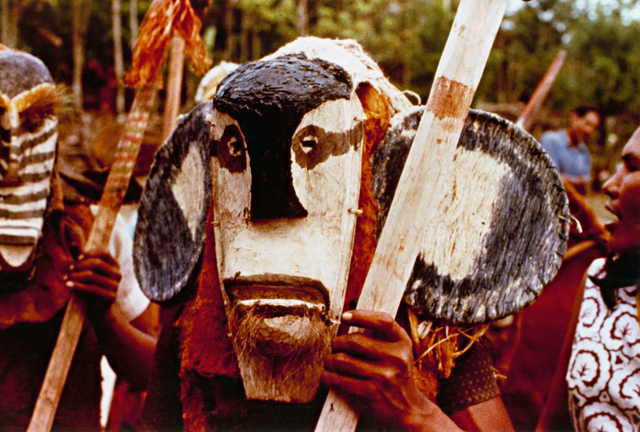
Myths tell how things came to be as they are. They tell how divinities, humans, animals and plants became distinct from one another. Rituals, for their part, take the inverse path to myths. And, not by chance, they frequently work to recount and recreate myths, initiating a kind of return to this time of general indistinction in which divinities, humans, animals and plants communicated among themselves and produced their existence through this interaction.
Indigenous populations believe that this communication and interaction must be undertaken in mediated form and that it is indispensable to the production of persons and society itself. After all, it is from the mythic cosmos that the raw materials for the constitution of persons and society are extracted. Losing sight of this communication and interaction means succumbing to inertia, the remaining in a world without meaning.
Initiation rituals, for example, involve separating neophytes (initiates) from everyday social life and forcing them to pass through a liminal state in which the boundary of the human social world seems to blur. Only by passing through this liminal state can the neophyte return to this world, now transformed.
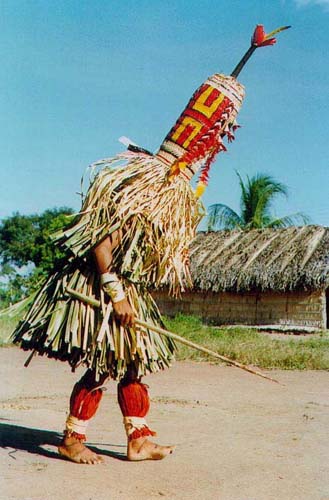
Funerary rituals, for their part, involve separating the living from the dead, ensuring that the latter return to another, non-human world. Each death places the living involved with it in a state of liminality. Unsurprisingly, therefore, funerary or post-funerary rituals among indigenous peoples very often provide the context for initiating young people.
This ritual communication is established among human beings and non-human beings, such as spirits, divinities, the spiritual owners of natural species, subjectivities that inhabit animal bodies and plants, and so on – all endowed with different capacities. But we cannot forget that this communication ends up taking place between individuals of different origin: people from other villages, other territories and even other ethnic groups.
Indigenous rituals are a celebration of differences. Firstly of the differences between the beings inhabiting the cosmos. Humans know that much of what they possess – what we call culture – was not merely ‘invented’ by themselves but taken, during mythic times, from other species and even enemies not seen since the distant past. Indigenous rituals are, moreover, a celebration of differences between human beings themselves, differences without which there would be no exchange or cooperation. And to celebrate these differences an intense network of repayments – above all of food and drink, but also on some occasions songs and artefacts – is set in motion.
[August 2008]
A panorama of diversity
Bororo
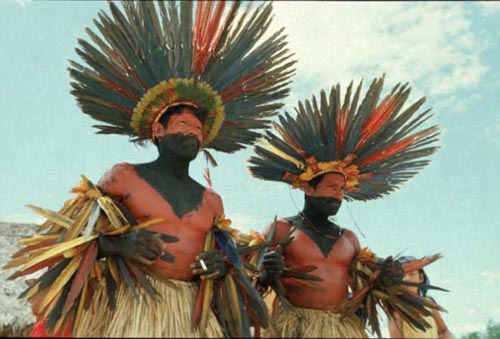
The funerary ritual of the Bororo (State of Mato Grosso) is a special moment of socialization for the young. Not only because many of them are formally initiated then, but also because it is through their participation in the collective chants, dances and hunting and fishing expeditions that they have the opportunity of learning and grasping the wealth of their culture. Photo: Kim-Ir-Sam, 1973.
Krahó
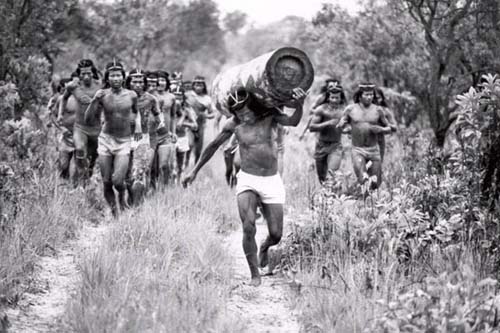
In the log race, which is associated with several rituals, the Krahó of the State of Tocantins form two groups, called 'halves'. Each of them carries a section of the trunk of a buriti palm (or another tree), whose format, size and decoration may vary. The Krahó are a Timbira group of the Jê linguistic family. Other Timbira and Jê peoples also perform the log race. Photo: Michel Pellanders, 1989.
Kanela
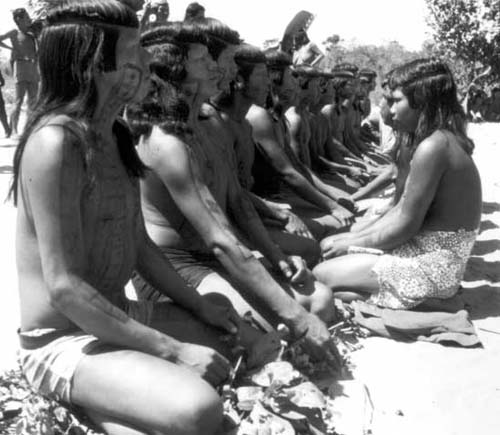
Among the Kanela (State of Maranhão), a Timbira group, boys are introduced to their age class through several initiation rituals, intended to train them to become warriors. Traditionally, the coming of age of the girls is associated with a maturity belt, required before they get married. Photo: William Crocker, 1975.
Enawenê-nawê
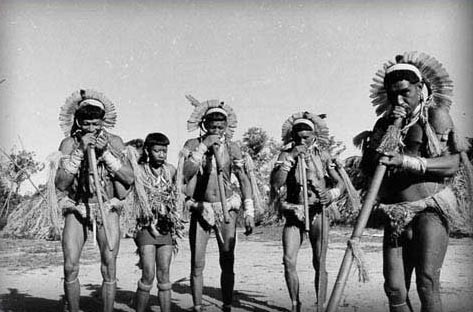
In the yãkwa, a ritual performed by the Enawenê-Nawê of the State of Mato Grosso, the villagers, divided in clans, exchange food, chants and dances. The ritual, which lasts several months and has two phases, aims at putting into practice the teachings of the underground spirits, yakairiti. Photo: Vincent Carelli, n/d..
Karajá
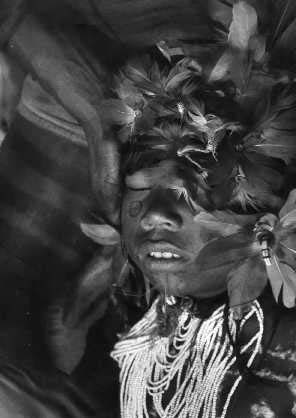
The first initiation of the Karajá boys, from the States of Mato Grosso and Tocantins), takes place when they are around seven or eight years old. It consists of the perforation of the lower lip, which will receive an ornament. The perforation is made with a monkey's collarbone, and is performed in front of the parents. Photo: Cláudia Andujar, n/d.
Yanomami
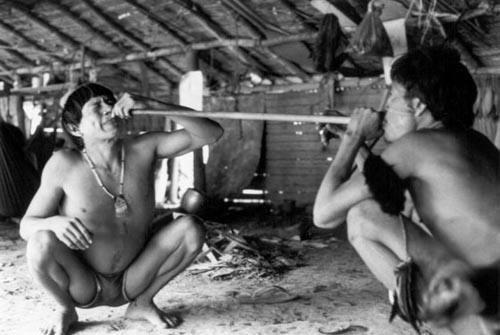
At the Toototobi hut, of theYanomami of the State of Amazonas, men participate of a session with the hallucinogenic powder, yãkuãna. Very much present in the initiation of the yanomami shamans, it can be taken only with the supervision of older shamans. Photo: Milton Guran, 1991.
Xingu
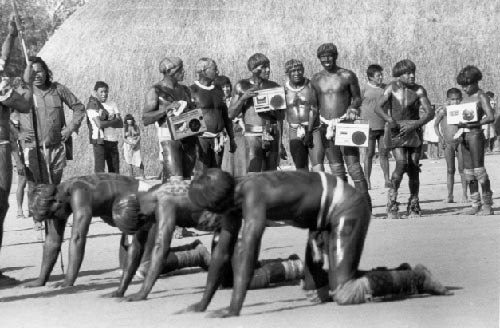
Xingu men participate of the huka-huka in the village of the Yawalapiti, in the State of Mato Grosso. This contest is part of the intertribal ritual called kwarúp, performed to honor the dead of the various groups that live in the Upper Xingu River region. Photo: Milton Guran/ 1985.
Kadiwéu
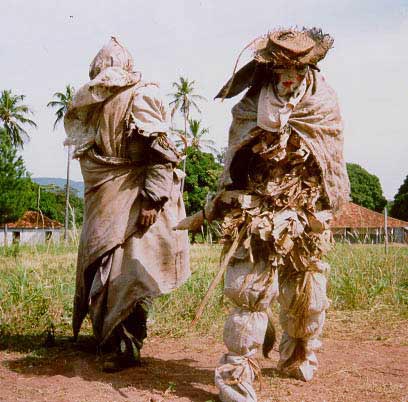
Os bobos (bobotegi) são personagens que figuram na Festa do navio, realizada pelos Kadiwéu. Este longo ritual remonta aos tempos da Guerra do Paraguai, quando este povo lutou pelo Brasil.
Pankararu
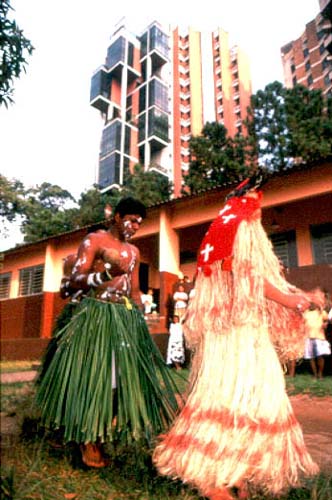
Apesar de desterrados na cidade de São Paulo, os Pankararu, que migraram do estado de Pernambuco, continuam realizando suas cerimônias, cantos e danças.