Kanoê
- Self-denomination
- Where they are How many
- RO 319 (Siasi/Sesai, 2014)
- Linguistic family
- Kanoe
The Kanoê are found relatively dispersed in the southern region of the State of Rondônia, near the border with Bolívia. It is possible, however, to recognize two different situations of contact between groups of these people and the surrounding society. The great majority live along the banks of the Guaporé River and is characterized by by a long history of contacts with the world of the "whites"; in contrast with a single family comprised of three people who live on the Omerê River, tributary of the Corumbiara, who were first contacted by the Funai in 1995, when they are five, and who have remained in relative isolation. These Kanoê groups, each in its own way, are marked by tragic histories which have resulted in a significant reduction in population. Today, they struggle for their physical and cultural survival in a region that is overwhelmingly occupied by lumbermen, landjumpers, and other agents who often threaten the integrity and exclusive usufruct of their lands.
(update in April 2003)
The Kanoê of the Guaporé River
The Kanoê who live along the banks of the Guaporé River are characterized by an intense insertion in the way of life of Brazilian society. Most are married with members of other ethnic groups or with non-Indians and only three of them speak the native language. Nevertheless, according to the leader José Augusto Kanoê, they are aware that they are an indigenous people united by a common origin and by ties of kinship, and because of this they intend to develop projects to revitalize their ethnocultural and linguistic identity.
The Kanoê live with other indigenous peoples on the Rio Branco and Rio Guaporé (the old Ricardo Franco Indigenous Post) Indigenous Lands, as well as in the municipality of Guajará-Mirim. There is even a family living in the Pacaás-Novas Indigenous Lands(P.I. Deolinda) and other families on the Sagarana Indigenous Lands, both inhabited by the Wari. According to the testimony of the Kanoê Munuzinho (who lives on the P.I. Deolinda) in January, 1997, there are possibly still other groups of their more distant kin living in other regions of Rondônia, about whom there have been no reports for a long time.
The Kanoê of the Omerê River
In contrast with the inhabitants of the banks of the Guaporé, this Kanoê group is considered a group of "isolated Indians" by the Funai, having been contacted by them only in 1995, after ten years of attempts by the contact front (today called the Ethnoenvironmental Protection Front). The group consists of a single family, comprised of the mother, Tutuá, about 50 years old; a daughter, Txinamanty, about 30 years old; a son,
Purá, around 25 years old; and two grandsons, one of whom is called Operá, five years old, whose father is Babá, the chief of the Akuntsu, another very much reduced "isolated" indigenous group on the Omerê. The other child was born in the beginning of 2002. In the beginning of 2003, Tutuá and the boy Operá, then seven years old, gotten malaria (a febrile disease) and died.
This family is monolingual in Kanoê and, having fled into a forest reserve of a ranch, they were able to survive from direct contact with the white man, despite the massacres which resulted in the near dissolution of the group.
Back in 1943 in the report of Estanislau Zack to the Rondon Commission, it was recorded that there were Kanoê Indians located on the left bank of the Omerê River, tributary of the left bank of the Corumbiara (Cf. Maldi, 1991:263). Much later, in the mid-70s, the Funai was informed about the possible presence of isolated indigenous groups in the region of Corumbiara. In 1984, reports pointed to the existence of Indians in the forest reserves of areas that were being deforested by the lumber industry and to form cattle ranches, although local ranchers guaranteed that there were no more Indians in the region. In 1985 the Contact Front was created which officially initiated the work of contact and in 1986, an area of 63,900 hectares and 103 kilometers perimeter was interdicted for the attraction of isolated Indians. Since then, attempts have not ceased to destroy whatever vestiges of Indians by clearing the forest, constructing roads and attacking with tractors at the order of the ranchers. However, by means of aireal and land incursions, the contact team found various indications of indigenous presence such as gardens, trails, traps, dwellings, and articles of clothing.
The indigenists even gathered various statements from Indians and ranchhands. Several ranchhands affirmed that there were gunmen killing the Indians who sought to stop the cutting of the trees. A Sabanê Indian woman (Nambiquara branch) reported the visit of three unknown Indians: an old man, an old woman and a girl about 13 years old, armed with bow and arrow and carrying a Mamaindê (nambiquara) basket, which they found on the riverbank, a gourd with honey and another with collars of black shells. They also carried a stone and stick with artifacts to make fire. They said they were looking for companions who had dispersed more than a week before, when, one night, they were forced to flee by a tractor that bulldozed their houses and cut through the middle of their gardens.
In May, 1986, the federal judge of Porto Velho deferred a Security Order, petitioned by the ranchers of the interdicted area, ordering the suspension of the President of Funai's decree. But the indigenist agency appealed and the interdiction was maintained. The indigenist Sidney Possuelo was then put in charge of coordinating the work of locating the Indians. In his report, he declared that the area was being intensely cut up by roads used for removing lumber in all directions, with a large number of trucks passing through, hundreds of workers, planes constantly flying over the region and deforestations of more than 30 kilometers long. Possuelo then concluded that the area where there were the most vestiges of Indians had been totally devastated, but that until recently it had been inhabited by a much reduced indigenous group which possibly had abandoned the region, pressed by the circumstances. Thus, in December of the same year, the interdiction of the area was lifted, and the ranchers regained ownership of the area.
However, the indigenists of the Contact Front, Marcelo dos Santos and Altair Algayer, did not give up their investigations. Extra-officially, in the following years they continued searching for and getting together evidence, raising hypotheses and getting around the obstacles set up by lumbermen, landjumpers and cattle-ranchers. In 1993, the indigenists began to rely on a valuable resource: recent satellite images made it possible to cross with precision accumulated evidence of the presence of the Indians with strips of forest left from the clearings of the ranches. Then they began systematic tracking of these regions of the forest. On the first two expeditions they found nothing. They tried a third time and the evidence appeared again. Finally, they located on a satellite image a red dot (sign of deforestation) the size of a pinhead, in the middle of a strip of forest six by four kilometers. They marked the coordinates and the team confirmed the location of the village.
One month later, in September 1995, they prepared a new expedition, this time certain that contact would occur. They called reporters and, with the help of a compass, they found the village four days later. The first contacts were amply publicized in the press, especially by the journal O Estado de São Paulo, by the magazine Veja and by the TV Globo program Fantástico, with images produced by Vincent Carelli, anthropologist and cameraman of the Center for Indigenist Work/SP who had followed the case since the 80s.
According to the report by Pablo Pereira, journalist of O Estado present on the occasion, on the top of a slope two Indians covered with adornments appeared. They seemed withdrawn. He, about 1.60 meters high. She, shorter, dark skin, barefoot, carrying bows and arrows. They talked loudly in an unknown language. By means of gestures, the members of the Contact Front tried to demonstrate that the visit was peaceful. The first steps of the couple were timid. The woman began a cerimony in which she appeared to grasp evil spirits in the air and blow them into the forest. On aproaching the whites, they touched their arms and hands. The woman trembled. The man babbled an unintelligible sound. Later, all of them smiled. The Indians indicated the presence of another group in the same area, which they referred to as "Akuntsu". In fact, a month later, contact with the Akuntsu was made.
After the contact was proved, the area was again interdicted, a decade after the first interdiction. The ranchers reacted immediately, trying to spread a version that the contact announced by the Funai was a farce, set up with Indian actors. They even went to the village of the recently contacted Indians, accompanied by the Cinta-larga, to tape a counter-proof in video. After that, they requested from the Villas-Boas brothers an opinion with regard to the truth of both tapes, accompanied by a "present" of a new video cassete. The indigenists preferred to watch the tapes on their old machine and attested to the veracity of Carelli's material, as well as the images made at the ranchers' orders, with induced questions and reactions. Later, the "present" was returned intact.
After this episode, the Federal Police in Rondônia opened an investigation of the charge of genocide against the Indians, based on the accusation that the ranchers took Cinta-larga infected by flu to contact the Kanoê, who had as yet not been immunized.
After that, contact of the Funai team with the Indians came to be more frequent, although they were still not identified ethnolinguistically. At the time of first contact, the Funai did not have any indigenous interpreters. From the recordings made by Vincent Carelli, interpreters of the Mequém language, another people whose survivors live in indigenous areas of Rondônia, were tested but without results.
The indigenist Inês Hargreaves collected a list of 123 palavras by means of contact with two Indian women of the group, which allowed Nilson Gabas Jr., linguist of the Museu Goeldi of Belém, to identify a great proximity with the Kanoê language. An elderly man of about 70 years of age, who spoke the Kanoê language - a language considered by linguists to be practically extinct - fluently, was quickly located on the Guaporé Indigenous Land. With the good understanding that Munuzinho Kanoê had of the tape recordings, and the answers the Indians gave on contact with him, the Indians were identified as Kanoê.
A Funai camp was set up at the entrance to one of the forest reserves, on the banks of a small stream, tributary of the Omerê. A medical and a dental team began making regular monthly visits to the village and a nursing assistant, trained in first aid, stays at the camp continuously for three weeks every month. There is even an employee to protect the Indians, in the absence of the chief, from eventual interferences by curious outsiders or intruders (such as cowhands, lumbermen, and extractors of palm cabbage), as well as to keep watch over the camp for possible retaliations by annoyed landholders and lumbermen.
In January, 1999, a technical group was formed to define the limits of the Omerê Indigenous Land, inhabited by the Kanoê and Akuntsu, which delimited an area with 26,000 hectares and 81 kilometers perimeter. The Land was declared official by the Ministry of Justice in december of 2002 and awaits homologation by the President of Republic.
Stories of before official contact
In relation to the specific history of the Kanoê of the Omerê, in the beginning of 1996, the employees of the Contact Front, Marcelo do Santos and Altair Algayer, with Munuzinho Kanoê as interpreter, got the first statements from the group. Below, we summarize in part the story of how only the family of Tutuá survived.
The group then had approximately 50 people, most of whom were women and several children. One day, the men got together and decided to go on an expedition looking for other peoples, with whom they could negotiate several marriages. All the Kanoê men, from the oldest to grown-up boys, went. The women were left only with their children. The days passed and the men did not come back. The anxiety among the women grew every day and two of them decided to go in search of the men. Three or four days later, they came back with the tragic news: their husbands and sons had been killed. The women entered in panic and, with no hope, they decided to commit collective suicide. They prepared a poison, gave it to their children to drink, and poisoned themselves. Tutuá, however, who had hardly begun to drink the poison found the strength to struggle for life and vomited what she had drunk. She also was able to save her children - Txinamanty and Purá -, her sister and her niece (Aimoró).
The Kanoê of the Omerê were thus reduced to two adult women and three children. But Tutuá's sister was not the same. She went crazy, not believing that the men were dead; she left her daughter Aimoró with Tutuá and, alone, went after her husband and boys. Tutuá even tried to stop her, but in vain: her sister left and she was never heard of again.
Tutuá, alone, raised her children and niece, seeking refuge in the forest. However, as soon as she had established contacts with the Akuntsu, she tried to get closer to them, in the hope of finding possible marriages for her children. But the relations between the two isolated indigenous groups were not always friendly, not only because of the linguistic barrier, but also because of the accentuated cultural differences between the groups. From what Marcelo dos Santos could gather, through Munuzinho Kanoê as an interpreter, Tutuá Kanoê always tried to get her children closer to the Akuntsu, in the hope that Babá, the chief, might come to give one of the girls as a wife for her son Purá. At the same time, Tutuá hoped that her daughter Txinamanty and niece Aimoró would get pregnant by Pupaki, an Akuntsu man, or by the chief Babá himself. But the attempts were always frustrated. Every time they got close, conflicts and death threats against the Kanoê arose, which ended up being concretized. Because she was more nervous and aggressive with the Akuntsu, Aimoró was killed by them. This death worsened the relations between the two groups even more. Despite the instability of living together, however, Txinamanty Kanoê got pregnant by the chief Babá and, in October of the same year, a boy was born. The Kanoê boy gave his name, Operá ("jaguar") to the newborn and adopted the name of Purá ("cricket").
With Aimoró's death, the Kanoê became relatively sadder than they already were, for, besides being the pajé of the group, Aimoró still had a happy, more festive spirit. It was she who organized the few rituals that the Kanoê still held. The Kanoê still insisted in getting close to the Akuntsu, but the conflicts continued. To minimize the problems, the indigenists intervened and suggested to the Kanoê that they move their village to another forest reserve, on the banks of the Omerê stream, approximately three kilometers from the Funai camp.
Language
The Kanoê language, also referred to as Kapixaná (Kapishana) or Kapixanã, is presently spoken by only seven people. In the southern region of Rondônia, there are still 40 indigenous languages surviving, most of which are related to eight macrofamilies, and various "isolated" languages, that is, languages for which there still have not been discovered consistent evidence of kinship with other languages or language families.
Of the seven speakers of Kanoê, three elderly people inhabit the region of the banks of the Guaporé River, characterized, as has been said, by an ancient and intense contact with the regonal population, given that most members of the group (around 87 people in 2002) only speak Portuguese. The group of the Omerê, on the other hand, contacted in 1995, is reduced to a single family of four monolingual speakers of Kanoê.
The Kanoê language has been classified as "isolated" (see Rodrigues: 1986 and Adelaar: 1991), although Greenberg (1990: 34, 49,55) tries to relate it to Kunsa, and Price (1978) supposes it to be one of the languages of the Nambiquara family. In effect, Greenberg (1997: 94-98) presents a few bits of evidence that Kanoê may belong to the Macro-Tucanoan trunk, but which are insufficient to prove such a classification. From the typological point of view, Kanoê is a morphologically agglutinative language, such that the words - principally the verbs - are formed by sequences of meaningful particles.
Perfectionism and hospitality
In their physical complexion, the Kanoê are not big-bodied, with a stature of more or less 1.70 meters. The group of the Omerê wears their hair clipped very short, for which reason Munuzinho Kanoê declared that his kin was known as "Dry Heads".
Although they presently live relatively sad as a result of their material life conditions and lack of perspectives, the Kanoê are gentle and receptive. The group of the Omerê is characterized by an accurate perfectionism, which can be observed in their material culture and maintenance of the village, which always has its patio very clean and swept, including the trail that goes to the stream. The trail that goes to the village is also kept clean and cleared of roots so that the Funai employees or members of the medical and dental teams who give them regular assistance can get to the village by motorcycle. In order to do so, Purá, whenever he can, always seems to be cleaning the way, taking out roots, levelling it and gradually burning a thick tree, which has fallen across the way, and which prevents the passage of vehicles.
In front of the central maloca where they sleep, under the covering which serves as a kitchen for them, each one seems to have his/her place marked. On visits to the village, when all were present and assembled, they always sat in the same positions: the mother, Tutuá, always to the left side of the fire; Txinamanty, taking care of her son Operá or giving food to him, always at one of the extremes of the cooking area, facing her mother; Purá, on the other half of the kitchen, where they also tied up the pigs to be fed.
The Kanoê have become notable as hospitable and courteous with the visitors. As soon as one arrives, they offer the visitor a full cup of cool and refreshing corn chicha (a kind of juice), lightly sweetened. After contact with the Funai, they only drink filtered water and prepare their chichas and other foods with water that is treated in porous clay filters, typical of Brazilian houses, for the people of the camp gave them one of these pieces of equipment to protect them from possible sicknesses deriving from contamination of the waters of the Omerê. When one leaves the village, they always seek to give something, especially bananas. In the same way, when they visit the Funai camp, whenever they can they take some form of present such as fish, a piece of game or some fruits.
Productive activities
The Kanoê are agriculturalists, hunters, fishers and gatherers. They raise chickens and wild pigs (queixadas), they make manioc gardens and plant sugarcane, corn, yams, sweet potato, peanuts, and tobacco. They also cultivate bananas, papaya and pineapple.
In the making of their gardens, the place is carefully cut down, burnt, cleared of stumps, and weeded. The gardens seem to be organized into specific sectors: sugar cane here, manioc there, peanuts over there. The same care is given for the animals they raise: the chickens have a coop to protect them. The pigs also have two houses the walls of which were made with wooden trunks stuck in the ground side by side and covered by woven palmleaves. The doors, made of split wooden boards, have a system of locks that allow them to keep the wild pigs penned up and protected from other carnivorous animals, especially jaguars, during the night. They also make use of the gardens of the Funai camp, from which they get manioc and yams, papayas and bunches of coco, every time their gardens are lacking. From what could be observed, the Kanoê have a relation of friendship and courtesy with the people of the camp.
Another trait which characterizes them is their disposition for work. The old woman Tutuá always wakes up very early and, armed with a machete, her bow and arrows and a big basket on her back, goes out searching for bunches of cocos, above all in the area of the camp where there are many palmtrees. After gathering them, she takes each fruit from the bunch, sets them in the basket and goes back to the village. Even with a heavy basket, she walks nearly three kilometers ever alert to the possibility of finding game animals. Once back in the maloca, she toasts the cocos, bit by bit, on the coals of the oven. Then, she breaks each one into four and, with a knife, she takes out the cooked pulp and, as she does this, she throws pieces of the pulp for the pigs to eat. It's a daily task, repetitive, which she always seems to do willingly.
Material culture
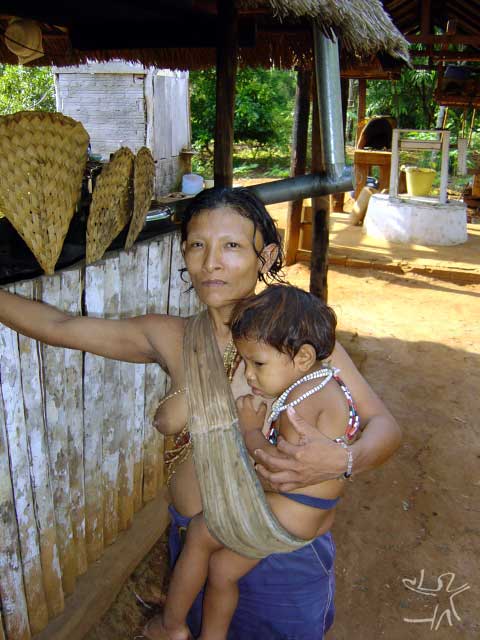
Even before their first contact with the Contact Front, the Kanoê of the Omerê used various multicolored collars made of plastic. They also typically used a hat, of the same model as a white man's hat but made of strips of woven palm and, on the brim, ribbons of black plastic canvass. Besides that, at the time of contact they were already using pieces of clothing made of industrial cloth (which they got from jute sacks), which they themselves made. Besides that, there were various utensils found in the village, such as metal forks and knives, aluminum cans and plastic wrappings of various products. These materials were collected by the Kanoê during their incursions into the forest, probably left behind in the camps of lumbermen, rubber-tappers and gatherers of palm cabbage in the middle of the forests or pastures. After Munuzinho Kanoê's visit, they asked for pieces of clothing and shoes, which they received. Only the old woman Tutuá goes around bare-breasted, although she is partly covered by a large number of layers of collars, some of plastic material, others of shells and seeds.
The collars of plastic material are comprised of trapezoidal or circular plastic material tied together with waxed string made of tucum fibre or cotton. These plastic pieces seem to have been cut from old plastic buckets, left behind from the incursions of lumbermen or cabbage palm gatherers in the forest reserves or pastures. The collars attest to the perfectionist style of the Kanoê, for the pieces all have exactly the same shape and design and, besides that, they are partially overlaid monochromatically or with alternating colors, predominantly orange and white, which gives them a beautiful visual effect. The collars are accompanied by earrings made of pieces of the same plastic material, of the same geometrical shape and size. The women, Tutuá and Txinamanty, use white earrings and Purá, the boy, orange-reddish earrings.
Their attire is completed by a long wreath of loose buriti fibres; various bracelets, several of which are similar to the collars; anklebands and kneebands made of woven straw or cloth. These adornments are used by the younger people over their shirts. Besides that, the Kanoê on occasion use two long red macaw feathers, which are stuck in a small botoque made of tucum bone, placed in a hole between the nostrils.
In their village, they do not use all these adornments all the time, but they insist on using their collars, bracelets and wreaths of buriti fibre. As soon as someone approaches, the Kanoê immediately seek to put their hats on or, at least a bonnet. On the other hand, when they visit the Funai camp, most times they dress up, using all of their adornments, including the macaw feathers crossed through the nose.
The hat is made in two ways. The first type is of one piece, made out of woven straw from stems of palm leaves, especially buriti, with a fixed brim. The other type of hat has the same model but consists of two independent pieces. The first piece is a cap in the form of a half-sphere, made in triangular sections of animal hide or cloth, sewn together by hand, with extreme perfectionism. The second piece is a loose circular brim, fit to the head of the user, woven in fine strips of taquara mixed with thin ribbons of black plastic canvass, tied together with buriti straw in such a way as to form a regular design. In the final tying together, the taquara points are fastened together with straw fibres of the buriti leaf. On this point, they put long macaw feathers, especially red ones. This loose brim is fit to the head, after putting the cap on, giving the impression of a hat of one piece. Thus, when they are in their village, often they only use the cap.
The perfectionism of the Kanoê is reflected even in the making of their arrows and adornments. Purá has a leather bag, in which he keeps all the material he needs for the making of bows and arrows. The bird feathers are carefully separated in sets by type and color, and tied together by waxed strings of tucum fibre. In the same bag, Purá keeps stocks of plant fibres or strips of plastic material, carefully rolled up, as well as tufts of beeswax to make the strings and the ties for the arrow feathers and points impermeable.
The Kanoê village on the Omerê has five dwellings without any internal divisions or windows, only a door in the front and one in back. The roof is two-sloped and extends to the ground, with the supporting structure consisting of trunks. The malocas are covered by açaí (Euterpe oleracea) or inajá (Pindarea concinna). The ground is carefully beaten and levelled on the inside and around the houses.
With regard to rituals, the Kanoê of the Omerê hold numerous shamanic rituals and cerimonies, when they snuff angico powder. According to Maldi, the work of the shaman with this hallucinogen is characteristic of the indigenous peoples of this region: angico seeds are ground up to powder and then mixed with a special kind of tobacco, cultivated for this purpose. The shamans also use a special lexicon, apparently unintelligible to the ininitiated, which they recite during the curing process. The shaman (female) of the group of the Omerê is Txinamanty, who does cures and deals with daily incidents.
Sources of information
- BACELAR, Laércio N. Fonologia preliminar da língua kanoê. Brasília : UnB, 1992. 119 p. (Dissertação de Mestrado)
- --------. Fonologia segmental da língua Kanoê : uma análise preliminar. Signótica: Revista do Mestrado em Letras e Lingüística, Goiânia : UFGO, n.6, p.59-72, 1994.
- --------; PEREIRA, Cleiton dos S. Aspectos morfossintáticos da língua Kanoê. Signótica: Revista do Mestrado em Letras e Lingüística, Goiânia : UFGO, n.8, p.45-55, 1996.
- BACELAR, Laércio N.; SILVA JÚNIOR, Augusto R. A negação e a litotes na língua Kanoê. Signótica: Revista do Mestrado em Letras e Lingüística, Goiânia : UFGO, n.9, 1998.
- MALDI, Denise. O complexo cultural do Marico : sociedades indigenas dos rios Branco, Colorado e Mequens, afluentes do Médio Guaporé. Boletim do MPEG: Antropologia, Belém : MPEG, v.7, n.2, p.209-69, dez. 1991.
- --------. Populações indígenas e a ocupação histórica de Rondônia. Cuiabá : UFMT, 1984. 149 p. (Monografia Curso de Especialização)
- MINDLIN, Betty. Antologia de mitos dos povos Ajuru, Arara, Arikapu, Aruá, Kanoe, Jabuti e Makurap. São Paulo : Iamá, 1995. 67 p.
- SAKAMOTO, Leonardo. O último sobrevivente : equipe da Funai tenta contatar indígena que vive sozinho. Problemas Brasileiros, São Paulo : SESC, n. 338, p.18-20, mar./abr. 2000.
- SANTOS, Marcelo dos. Índios acossados em Rondônia. In: RICARDO, Carlos Alberto (Ed.). Povos Indígenas no Brasil : 1991/1995. São Paulo : Instituto Socioambiental, 1996. p.550-3.
- --------. Os “isolados” de Rondônia. In: RICARDO, Carlos Alberto (Ed.). Povos Indígenas no Brasil : 1996/2000. São Paulo : Instituto Socioambiental, 2001. p.594-5.
- VALADÃO, Virgínia. Os índios ilhados do Igarapé Omerê. In: RICARDO, Carlos Alberto (Ed.). Povos Indígenas no Brasil : 1991/1995. São Paulo : Instituto Socioambiental, 1996. p.545-9.
VIDEOS