Kulina
- Self-denomination
- Madiha
- Where they are How many
- AM 7211 (Siasi/Sesai, 2014)
- Peru 417 (INEI, 2007)
- Linguistic family
- Arawá
Living along the banks of the Juruá and Purus rivers, the Kulina are outstanding for the strength with which they maintain their cultural institutions, among them music and shamanism. An example of this is that, despite their being in contact with the Whites for a long time, and that several villages are located near urban centers, no-one knows of any Kulina living outside their lands.
Name and language
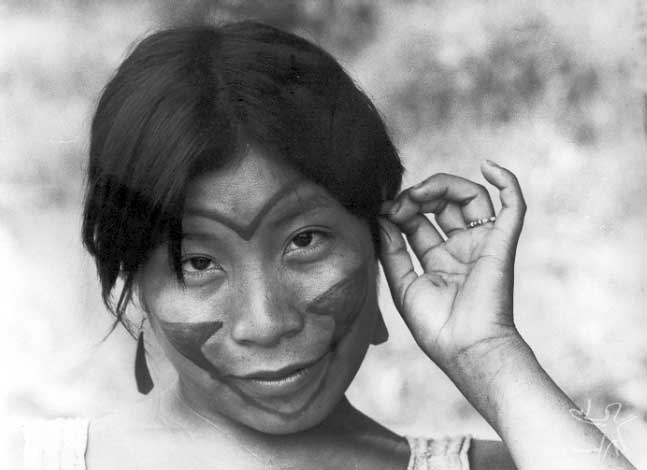
The Kulina belong to the Arawá language family and, until the arrival of the Whites, they were one of the most numerous groups in the state of Acre and south of the Amazon. Their self-designation is madija (pronounced madirrá) which means “those who are people", while the Whites are generically called by the term “cariás”.
The madija speak predominantly the Kulina language in the villages, even the children, and all of the (few) bilingual speakers are elder males. Generally, those who worked in their youth for white bosses in the rubber camps and in timber extraction have greater knowledge of the Portuguese language, although in the villages close to the cities the need to establish relations with the surrounding society is changing this reality. Many young people have been training to become indigenous teachers, agro-forestry agents, and health workers, especially after 1970 with the implantation of a FUNAI office in Rio Branco and the presence of organizations such as the CPI (Pro-Indian Commission) and the CIMI (Indigenist Missionary Council).
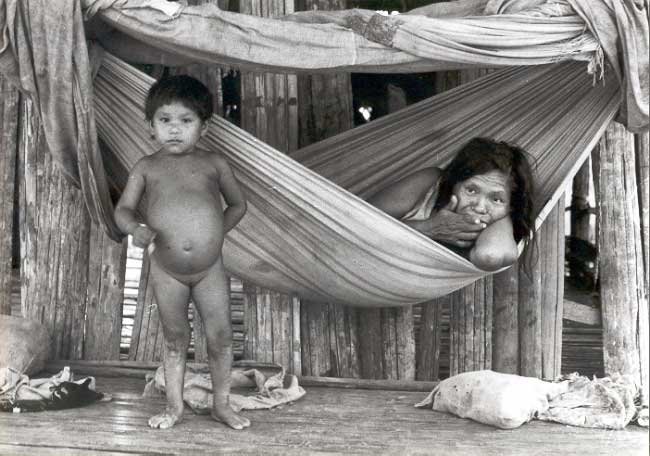
The female linguistic style is markedly different from the male style: there is occlusion of vowels, condensation of entire words, at times creating situations in which the simple translation of a spoken phrase of four or five words becomes a complicated task. Only the Madija understand what their women are saying and, as there are neologisms that vary from village to village, this understanding is at times restricted to the local group itself.
Several of the few white speakers of the Kulina language whom I consulted on the female songs, like the Lutherans and members of the CIMI, were emphatic in affirming their difficulty in understanding, if not the the meaning, then quite often the very word spoken, reiterating the possible existence of a peculiar female linguistic universe. The women use a specific technique in their songs which consists of inhaling air when they reach the end of a phrase and are pronouncing the last syllable. This can clearly be observed in the accent placed on the conclusion of the phrases, a characteristic which I only perceived in the female song and in their length. I had the impression that they were singing cyclically, sucking in air at the end of the phrase in order to get a bit more breath.
Location and population
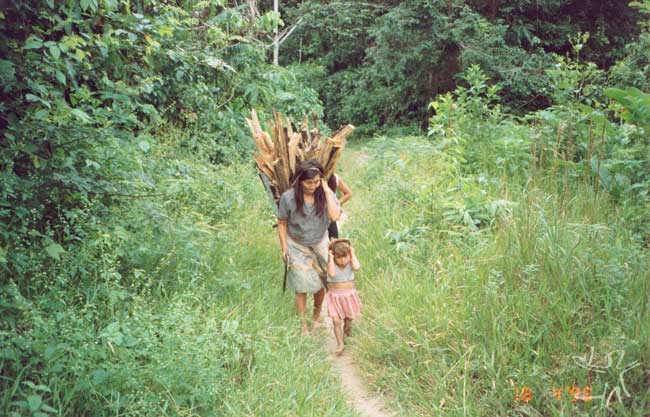
A large part of their population, these days, is found on the border of Brazil with Peru. In Brazil, they live in villages along the banks of the Juruá and Purus rivers(Acre), where they had a total population of around 2,500 individuals in 2002, according to data of the OPAN (an NGO: Operation Native Amazônia); while there were approximately 500 on the Peruvian side in 1998, according to the SIL (International Linguistics Society, formerly Summer Institute of Linguistics).
These days they live in five indigenous lands, all of which have been legally recognized, as follows: Upper Purus Indigenous Land (where the Kaxinawa and the Yaminawa also live); the Jaminawa/Envira Indigenous Land (where the Ashaninka also live); the Kaxinawa Indigenous Land of the Humaitá River (where the Kaxinawa and the Ashaninka also live); the Kulina Indigenous Land of the Envira River and the Kulina Indigenous Land of the Pau stream.
According to the data of the FUNAI in 2002, the Kulina of Acre had a population total of 1,737 individuals, distributed in 15 villages, the village of Canamari having the greatest concentration, with 680 people. To the south of the Amazon there are around 800 individuals, distributed in 19 villages.
History of contact
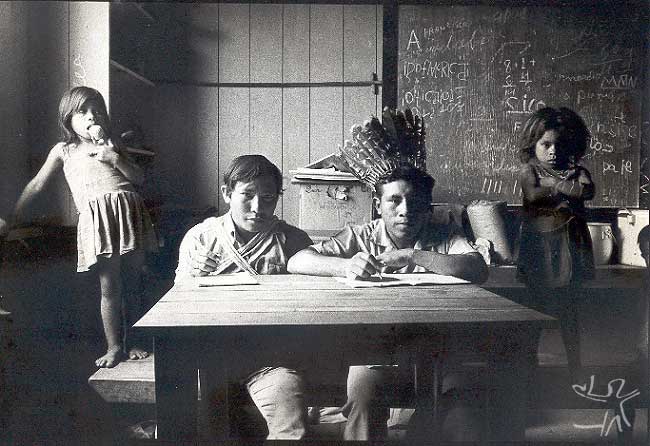
There is little historical information about this group, principally in the period prior to the end of the 19th Century. Until that time, the first outsiders to enter the region were basically commerical plant collectors and occasional hunters who had no interest or resources for making records.
As large tributaries of the Amazon, the Juruá and Purus are navigable for a good part of the year, principally over their lower and middle courses. The first travellers who passed through left impressions that were limited to the perception that a boat trip on the river offers, mainly of the floodplains [várzea]. Beyond the várzea, there were not only the Kulina, but other peoples located in the middle of the forest, who in that time were rarely seen.
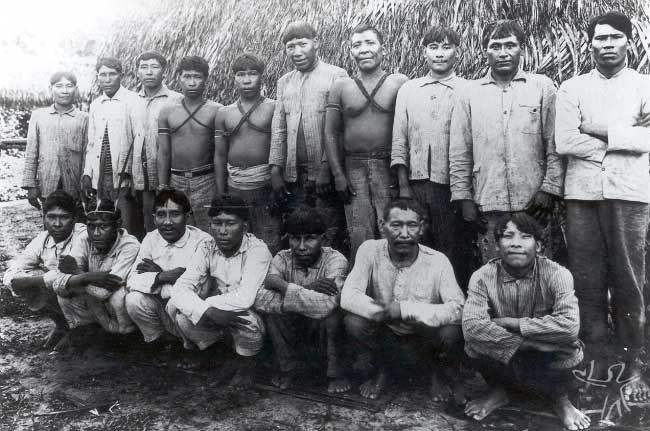
These first expeditions of commercial plant collectors exploited the Indians through commercial relations in which they would receive native turtles, spices, plant oils, timber of good quality, and cacao seeds, in exchange for tools, clothes, fishhooks and other industrialized products.
In 1837, the Englishman W. Chandless, produced a detailed report on the region for the Journal of the Royal Geographical Society, in which for the first time references to various peoples appear, among them the Kulina, also called corinos and kulinos.
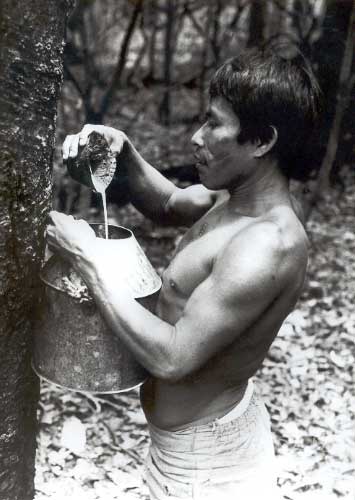
The first regular contacts of the Kulina with the cariás [Whites] took place with the rubber-gatherers during the rubber boom at the end of the 19th Century, when they were at that time living in the forest. Due to the bloody raids or "correrias", referring to the violent incursions organized by Brazilian rubber-gatherers and Peruvian caucheiros, the Kulina fled in the direction of the headwaters of the rivers of the region. There was a double movement caused by the direction the rubber-gatherers and caucheiros took, not only of the Kulina but also of other ethnic groups who headed for the headwaters of the rivers they inhabited. One came from Peru to the Amazon and the other went up the Amazon tributaries in the direction of Bolivia and Peru, and in the case of the Kulina, mainly on the upper Purus and Juruá.
The difficulties in transporting the production out of the area due to difficulty of access represented setbacks in the establishment of rubber camps along the rougher parts of the rivers, principally when the river level was low, which meant less non-indigenous interference in the lives of the Kulina and other ethnic groups.
After the implantation of the rubber camps, the need for manual labor to keep up the dynamics of the trading post became evident: the perverse system of selling merchandise on credit allowed the rubber boss to hold the rubber-gatherer prisoner to unpayable debts, which were contracted for his own sustenance and that would be paid with his rubber production.
The promise of easy and abundant wealth provided by the dream of rubber stimulated the migration of Northeasterners to this area. Also the “correrias” intensified in all areas and were done with the objective of taking Indians captive to work in the rubber camps. With the passing of time, the very need for domestic utensils, weapons, cloth, and the conveniences of contact in the trading posts on the banks of the rivers ended up drawing the Kulina and other ethnic groups in the region closer to the Whites.
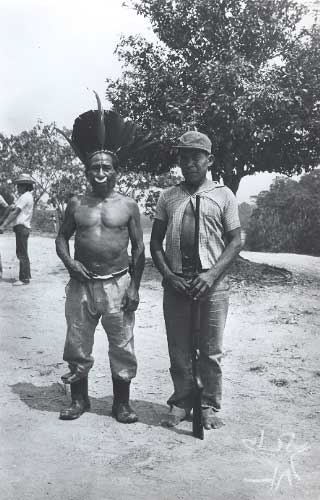
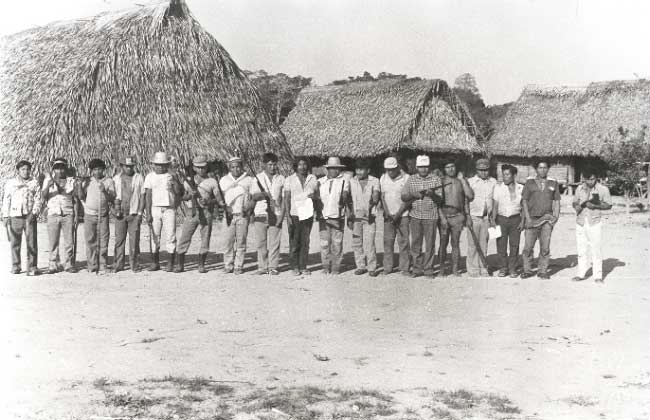
Only in 1984, in alliance with the Kaxinawa, did they on their own initiative undertake the demarcation of the Alto Purus Indigenous Area, which was followed by the interdiction of the area by the FUNAI on July 31st, 1987, for the purpose of study and definition. Official demarcation was completed on January 5th, 1996. Historically, the Kulina, along with other ethnic groups, have survived among hostile groups, with war on their enemies having been a constant process, and even today they maintain joking relations with other groups of the region, including their neighbors the Kaxinawa, although this temporary alliance is more of a precise and necessary diplomatic strategy with an ancient rival.
Although the legal situation of their lands is regularized, the social pressure provoked by interaction with ranchers and neighbors, by conflicts with hunters and fishers, besides the frequent invasions of their lands for illegal extraction of lumber, demands constant attention and permanent strategies in the sense of minimizing the impacts that these interactions cause and could cause..
Social organization
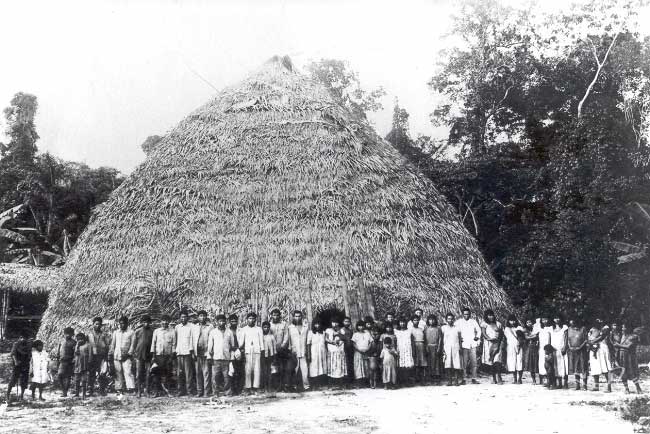
In the past, the Kulina used to live in large straw longhouses, which had two openings one situated on the eastern side and other on the western side, and which housed large families. Now they live in houses built on pillars, following the regional style of Amazonian rubber-gatherer dwellings. The floorboards are made of paxiuba palm, varying from one to two meters distance from the ground. The rooves are covered with jarina leaves – a species of local coconut -, sloping, at an angle of approximately 45 degrees.
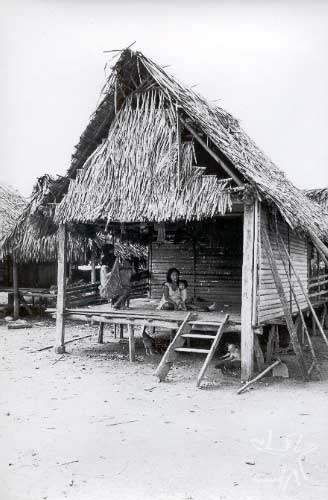
In the houses there is usually a room set aside that is utilized to keep objects of personal use, such as weapons, and also where most of the hammocks are. The area set aside for the processing of foods is located in the back part of the house and is connected to the main part by a suspended passageway of paxiúba strips, as opposed to the entrance of the house, where there are stairs. There is an area to the side of the closed room, in front of the kitchen, in which people eat and also converse and receive visitors.
The present-day dwellings house at the most around 20 people, the nucleus of which consists of a patriarch who lives with his grandchildren and daughters’ husbands. This situation holds until the the daughters’husbands build their own houses and plant their own gardens, which normally happens after the married couple already have children.
Kinship relations, descent groups (the sib) and mechanisms of reciprocity interact as a network of communications, in such a way that the various dimensions of the social sphere are related by a common denominator: the manaco (the Kulina system of reciprocity, also translated as exchange) which guides, if not defines, marital options and political alliances.
In the terms of this system, all men and women, including the whites, were created by the mythological heroes Tamaco and Quira, but only the Kulina are people: Madija. Among these madija peoples, there are the Madija ssaco ("people of the traíra fish"), Madija ccorobo ("peoples of the fasting fish"), among others, in all, around 76 known types of Madija, and each eponym characterizes the members of the descent group associated with it. The Madija ssaco, for example, are considered to be introspective, as it is believed the ssaco behaves. In this sense, not only society attributes to the different peoples characteristics of the animal or plant identified with them, but also the peoples themselves believe this is so. The thematic paradigm that constitutes this form of totemic classification is based on the differences between a natural series (animal or plant) which are attributed to and comprise the differences in the cultural series.
Bilateral cross cousins are the preferred spouses in marriage, normally from an ally sib, that is, where there is no case of conflict due to dori ("witchcraft"). There is even a Kulina expression for cross cousins, ohuini, which means “the one who is betrothed".
Below is a diagram of the preferential marriages in Kulina kinship:
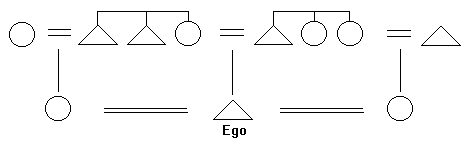 In Kulina marriage there is a series of rules that both sexes have to comply with. The husband has obligations to his wife’s father, in retribution for the concession of his wife, and receives in manaco (exchange; retribution) obligations from his wife’s brothers for taking care of their sister. These have to do especially with collective labor, such as the cutting of the forest for gardens, the building of houses and the making of canoes. He has to offer gifts and presents to the woman in exchange for their favors, a necessity which also has to be expressed publicly, as for example in the ritual of the Coidsa, in which the men return from the forest bringing food that they publicly deliver to their wives.
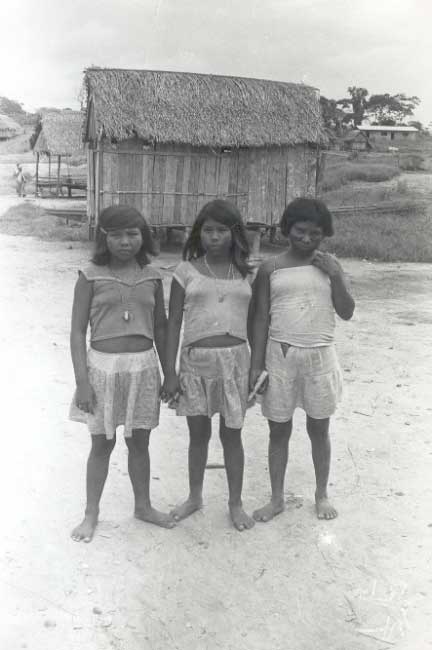
Normally, the lives of the girls begins at a very early age, 3 or 4 years old, to appear like that of their mothers. Despite their not having any chores to do in early infancy, they are encouraged to make a small fire and to play at cooking with small earthen pots made by their mothers. The mothers also make small buriti baskets for them, copies of the baskets that the older women use to fetch sweet cassava in the gardens, with which they accompany them and play at working.
Normally, older women, mothers, younger daughters, sisters-in-law and sisters go together to the gardens, bathe together, take care of the younger brothers, cook, and in short, participate in a female social universe in which the moment of getting married is only one more stage of a process that began very early and ends only with death.
Cosmology and cosmography
Kulina cosmography, that is, the spatial construction of the cosmos, delimits spaces for the spirit beings, plants and animals. In summary, their cosmography is a visual conception of the sky, earth and places that men and animals occupy from a geocentric point of view. This cosmography presupposes the existence of layers and, in each, places. The layers are basically the following: meme ("sky"), nami ("earth") and nami budi ("below the earth"). There is also dsamarini ("the place of the water") and two other differentiations of the sky that are infrequently mentioned.
Children, men and the dead occupy distinct places in this cosmography and in the system of reciprocity, since the native age categories are organized in the following way:
Children nono: newborn; non-person ejedeni:- child; person Young people dsabisso/dsohuato: (boy/girl) adolescent; until marriage maqquideje dsabisso (young man) and amoneje dsohuato (young woman): married young couple and without children Adults maqquideje/ amoneje: married man/woman, with children, house and garden jadahi/ jadani: old man/old woman Dead: non-person Men, animals and plants live on nami ("the earth"), while the spirits occupy the underworld, nami budi. The animals and game animals also live in nami budi, coming up to the earth to be hunted by the men. The pajé, when he drinks rami ("ayahuasca") or through his dreams, makes contact with the world of nami budi, visiting the great subterranean villages where the spirits live or bringing the animals up to the surface, near the village. To do this, he transforms himself into an animal also, given that the animals themselves of nami budi are metamorphosed spirits. I utilize the term transformation to refer to the process of modification of an animal into a person, and the term metamorphosis as the process of modification of a spirit into an animal, but not in opposition to each other. This cycle of transformations is based on a system of oppositions, which operates in a cosmovision that can be synthesized in the following manner:
spirit/metamorphosis shaman/dead
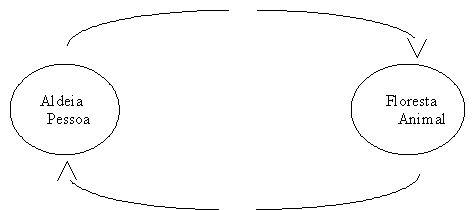
Body/transformation Newborn/game animal According to the cycle, undomesticated being, the nono, represented by the forest (nature, male), is domesticated through the ingestion of foods produced in the gardens, through female substances (maternal milk and saliva), through learning and understanding the myths and music, until one gets as close as possible to a totally sociable being. After adult life, this sociable being - maqquideje or jadahi, has two ways in which he may go back to nature, his origin: after death, when his spirit will go to nami budi, to the villages of his ancestors, being transformed into a game animal, or through the metamorphosis of the shaman into wild animals (normally the peccary).
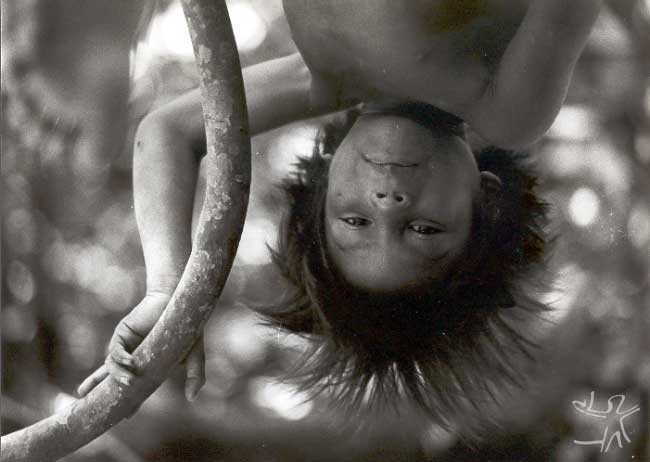
The shaman, assisted by his tokorimé (spirit, double, image, normally the peccary), goes to nami budi, the place of the dead and, by identifying his animal tokorimé with that of the other spirits of the dead metamorphosed into peccaries, succeeds in bringing them to the surface, near the village, where they then will be, by indication of the shaman, hunted and later devoured.
In the final cycle of transformations, the spirits are hunted and eaten by the living, which suggests a kind of endocannibalism, which is necessary in order for the spirit of the dead to be incorporated once again into the system of reciprocity, which he abandoned abruptly on dying. During this cycle, the physical/undomesticated body heads in the direction of the village, world of sociability. The other part, the spiritual/domesticated part heads to the forest, savage world, not yet domesticated. There is a relation between the physical body and the social world, as well as between the spiritual body and the world of nature, where the world of sociability is that of the living, while the wild world of the forest is related to the spirits: the dead. In this way, the spiritual/domesticated body, in its highest degree, goes in the direction of the world of nature and returns as a physical/wild body, through shamanic practices or death – the transformations of each occuring in the extremities of each place.
In synthesis, the elements of the cosmological system are: men who live on the earth and animals who live below the earth. The relation between men and animals is defined by food, in the form of game meat, or through the shaman, who brings the animals from the subterranean world to the surface by transforming into them.
Observing the madija dwellings, one perceives this relational distinction in their back part. Humans live on the paxiúba floorboards, where people eat, sleep, hide, and it is clean. Animals live underneath the house, separated by the floorboards, and the connection between them is one of reciprocity. In these dwellings, which imitate the pattern of the riverine population, food is processed in back of the house, and all the wastes – solid or liquid – pass through the floorboards down to the pigs and other animals who live there. As the pigs and other animals are transformed into food, a balanced form of reciprocity is established, which, despite having a spatial arrangement which is imported from the regional pattern, is supported by native categories of exchange.
Shamanism
For the Kulina sickness is basically caused by dori ("witchcraft"), which is manifest in the form of an object that penetrates the body of the victim through magical insertion, in the form of a small stone, or a piece of wood or bone, that will cause much pain in the body of the sick person. Although they recognize today that there are sicknesses that are not dori – the sicknesses of the white man, dsama coma, literally "sick earth" -, their system of beliefs invariably attributes them to dori which, if it doesn’t directly provoke the sickness, acts in the sense of predisposing the person to get sick.
Who throws dori is always the dsopinejé ("shaman"), who never acts against anyone from his own sib. In this way, either there is a shaman from a rival sib in the village or it is someone from outside, madija or not. Many conflicts have occured, and still occur, because of this in the form of negative Manaco (vengeance) between Kulina of different communities or other tribes.
The Western hygienic explanations that many sicknesses affect us because of human and animal (such as pigs) feces, in the form of microorganisms, do not find support in native categories, which makes the actions of health agents difficult. For example, in the symbolic domain, the pigs, likened to the peccary (jidsama, which can mean domestic pig or wild pig), have a special role in the myths (cycle of transformations), rituals (the coidsa: festival of fermented beer caiçuma, where men and women alternately present themselves choreographically to each other as jidsamas and offer each other caiçuma to drink) and in the Kulina food diet.
The pigs are often incorporated by the shaman as an animal of power: a tokorimé ("spirit"). On the physical plane, they are identified as models of the very social life of the Kulina, because they are domesticated and act in a collective way.
Music in Shamanism
The category of ritualistic music is called ajie (arrié), which can be translated as ‘mythical music’. Many ajie are ancient and shamanistic, and normally they are used in curing sessions to extract witchcraft (dori) from the body of the patient, following procedures similar to those described for other indigenous peoples.
According to the Kulina, in these sessions what happens is that there is an insertion into the body of the patient of the curing songs which are sung by the shaman and by the women, in group, accompanied by the blowing of tobacco smoke, which sometimes results, after nights of work, in the removal from the body of a small object, normally a small rock or a fishbone which was found in the body of the patient and was causing the sickness. This object is supposed to have been thrown, like a dart, by a shaman from another sib or from another people.
As a male domain, the shamanic songs – of ajie- and the songs of rami jinede -the mariri rami- are created only by men, most of the time shamans or apprentices. During the mariri rami there is a master specialist singer, the one who knows and sings the strophes that are repeated by the other participants in the cerimony, more or less an hour after the ingestion of ayahuasca. In the shamanic rituals, toccorimecca ajie ("songs of the spirit"), the women actively participate, singing in order to domesticate the savage dori in the body of the patient; such songs are taught and rehearsed by the shaman with this objective.
Implicit in the idea of removing a dori from someone is the notion that, despite its being an independent object, it contains the characteristics of the one who threw it. It is the songs that will make the cure possible, through the domestication of this dori, first through the tokorime (spirits who control them), followed by the songs that teach the foreign element, that is causing the imbalance, to harmonize with the new system of reciprocities and to come to be part of it.
This duality is relation to the dori fits into the dualism of the cycle of nature/culture transformations, in which to perform a cure means transforming the sickness, which is the uncontrolled dori, through song, into a kind of ressocialization of the dori.
The shaman needs to have knowledge and control over the bipolar nature of his being: the savage and the domesticated. It is with the savage dori that he can cause sicknesses, for shamans also are, on another plane, warriors, and in the case of rivalries or the need for practicing negative Manaco they use their power to send or send back dori to the enemy. As the very shaman possesses dori within himself, it is only by his extrapolating the limits of sociabilty that he transforms dori into imbalance and sickness; it is only for those who are strangers that dori acts by causing sickness.
As further elements of comparison, there are certain attitudes in relation to the dori. The act of sending it to someone (or to a village) is individual and masculine, for it is the shaman who in a solitary way sends the dori. Shamans are almost always men, although the act of curing and transforming is collective, and basically female, for although it is the shaman who directs the ritual, it is comprised by many women in a group, singing together to the sick person. Without them, the cure does not take place. In this sense, the sickness is created by a single individual, representing external nature, distant from the one who receives it (the forest, a distant tribe, an unknown enemy, outside of his/her own system of reciprocity), and health by the collective, by culture.
Music and daily life
Besides the shamanic rituals, Kulina musicality is expressed in the way that daily life is musically represented, whether vocally or instrumentally, during the long days on the upper Purus. One hears women singing to their children as they cook, or as they weave cotton in the garden for their hammocks, men and women playing their flutes, ajie songs at nightfall and the peculiar sounds of the musical bow: the jijiti.
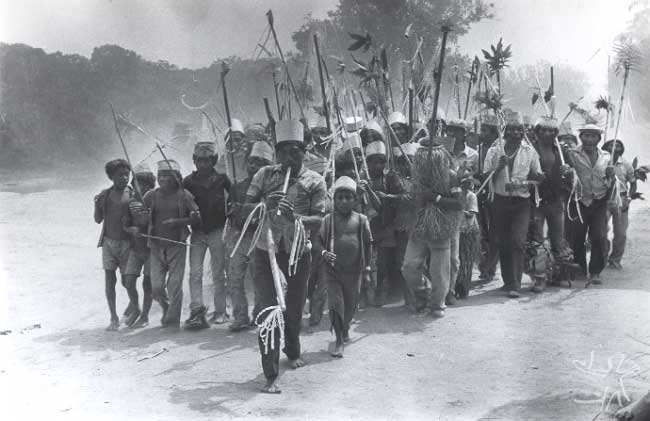
As the greater part of the songs have more or less regular rhythmic-melodic structures, it is common to hear two or more interpreters singing the same theme in different houses and in different times. This daily musicality is expressed mainly by the women; men rarely sing during the day. Not that there is any restriction to mens’singing. It seems, rather, that there is a division of attitudes and roles which has to do with the meaning of music for the Kulina. The men play their flutes, principally the younger men, to send love messages to their sweethearts, establishing specific social connections, for the whole group knows who is playing, what it is and for whom the music is intended, thus making collective the amorous expectation.
Shaper and mediator of senses in Madija society, music acts as an ideal conveyor of meanings. When they play their instruments, such as the totoré and boboreré flutes, as well as the jijití musical bow, the melodies and rhythms preserve similarities with the songs. Known by everyone, they function independently of the words, which does not mean they can be treated as frameworks, as forms awaiting content.Music acts as a labyrinthine central thread, that symbolizes the need for translation of the continuum, in which the world of the spirits, the mythic world and the perceptible natural world form one single whole.
Material culture and games
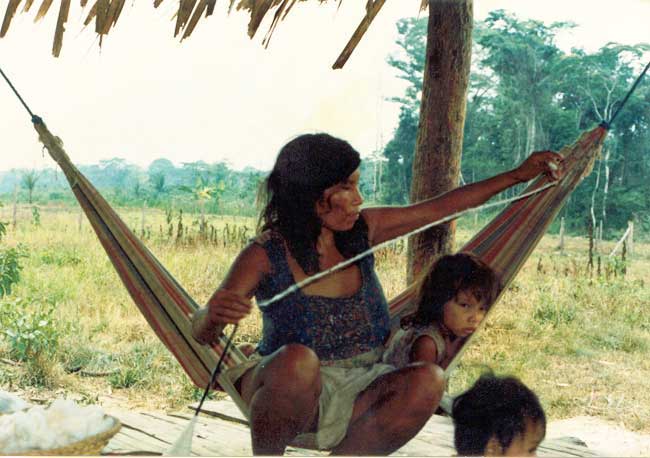
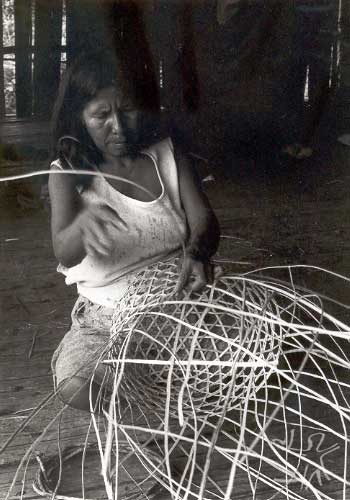
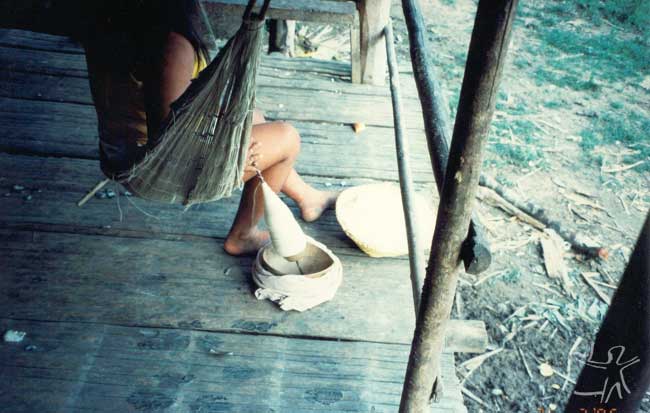
The Kulina have a command of the techniques for cultivating and processing of cotton, producing from it their clothes, dyed with urucum, as well as their hammocks, bags and belts, which they commercialize sporadically in the cities or through the numerous agents of contact who from time to time visit their villages.
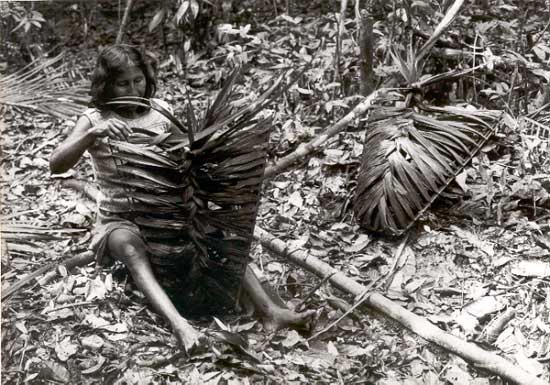
Like their neighbors the Kaxinawa, they produce collars with animal teeth, seeds and attribute great value to stones, at times giving them magical properties. They make great use of various species of palm trees for the making of ritual adornments, as well as hats with palm strips, skirts, and body bands. They are also famous for their works in hardwood, such as benches in the form of animals (alligators, tapirs and jaguars), besides the small sculptured dolls and boats.
Each village has a soccer field and there are frequent matches between villages which involve travelling for days, with games that last hours and hours and that usually end in a tie.
The Kulina women are famous for their cooking which, although the menu is relatively simple and repetitive, produces delicious plates, such as smoked and cooked fish, armadillo soups, pig meat cooked with herbs, a porridge made with water and smoked banana (bare pahani), among other delicacies passed from generation to generation.
Notes on the sources
The first bibliographical references on the Kulina appear in Chandless (1866), a geographer of the Royal Geographical Society, who travelled throughout the Juruá/Purus basin. Apart from occasional reports by travellers, it is only with Patsy Adams (1962, 1964) that the first information on these people begins to appear. Adams studied Kulina music and her work is valuable in the sense of providing clues to understanding their exceptional capacity for cultural resistance.
In 1978 we have the reports by Anthony Seeger and Arno Vogel on several tribes of Acre, besides the report by Eduardo Viveiros de Castro for the FUNAI, in the same period, which provides some information on the sib, problems of contact and the landholding situation.
In 1984 the valuable “Kulina-Portuguese and Portuguese-Kulina” Dictionary was compiled and published by Abel O. Silva and Ruth M. F. Monserrat.
In the 1980s and 90s, there was an increase in the anthropological production on the Kulina, besides the contributions of the Lutherans of the CIMI – among them, the works of Lori Altmann (1982, 1990) and Roberto Zwetsch (1993) -who worked more directly with this group. Among the anthropologists there are the works of Donald Pollock (1985,1992) on shamanism; the volume Acre: História e Etnologia [Acre: History and Ethnology] by the Nucleus for Indigenous Ethnology (1991, edited by Marco A. Gonçalves); the work of the Canadian anthropologist Claire Lorrain (1994) on gender, as well as the works by Domingos Silva (1997, 1998, 1999, 2001) on music, shamanism, and the notion of the person.
Sources of information
- ADAMS, Patsy. La música culina. Peru Indígena, Lima, n.24/25, 1964.
. Textos Culina. Folklore Americano, Lima, v.10, n.10, 1962.
- ALTMANN, Lori. O caso da doença de Queri. Outra Visão, s.l. : s.ed., v.2, n.4, 1985.
. Convivência e solidariedade : uma experiência pastoral entre os Kulina (Madija). São Leopoldo : Comin ; GTME, 1991. 53 p.
. Evangelização e povos indígenas. São Leopoldo : IECLB/Fac. de Teologia, 1982. (Trabalho de Conclusão do Curso de Teologia).
. Maittaccadsama : categorias de espaço e tempo como referenciais para a construção da identidade Kulima (Nadija). Porto Alegre : UFRGS, 2000. (Dissertação de Mestrado)
- BATISTA, Ana Cristina Borges. Kulina. In: GONÇALVES, Marco Antônio Teixeira (Org.). Acre : história e etnologia. Rio de Janeiro : Núcleo de Etnologia Indígena/UFRJ, 1991. p. 145-76.
- CHANDLESS, W. Ascent of the river Purus. Journal of the Royal Geographical Society, Londres, v.36, 1866.
- DEICKE, Nelson. Madija : resistindo a partir da cultura. Cadernos Comin, São Leopoldo : Comin, n. 3, 18 p., fev. 1994.
- ERIKSON, Philippe et al. Kirinkobaon kirika (“Gringos’ Books”) : an annotated panoan bibliography. Amerindia, Paris : A.E.A., n. 19, 152 p., supl., 1994.
- FUNDAÇÃO DE CULTURA E COMUNICAÇÃO ELIAS MANSOUR; CIMI. Povos do Acre : história indígena da Amazônia Ocidental. Rio Branco : Cimi/FEM, 2002. 58 p.
- MONTEIRO, Rosa Maria. “Vamos acabar nosso trabalho!” : a demarcação da Área Indígena Kulina do Médio Juruá. In: KASBURG, Carola; GRAMKOW, Márcia Maria (Orgs.). Demarcando terras indígenas : experiências e desafios de um projeto de parceria. Brasília : Funai/PPTAL/GTZ, 1999. p.155-66.
- POLLOCK, Donald. Culina shamanism : gender, power and knowledge. In: LANGDON, E.J. (ed.). The portals of power : shamanism in South America. s.l. : Univers. of New Mexico Press, 1992.
. Death and the afterdeath among the Kulina. Lat. Am. Anthropol. Rev., s.l. : s.ed., v. 5, n. 2, p. 61-4, 1993.
. Etnomedicina Kulína. In: SANTOS, Ricardo Ventura; COIMBRA JÚNIOR, Carlos E. A. (Orgs.). Saúde e povos indígenas. Rio de Janeiro : Fiocruz, 1994. p. 143-60.
. Personhood and Illness among the Kulina of Western Brazil. New York : Univers. of Rochester, 1985. (Tese de Doutorado).
. Personhood and Illness among the Kulina. Medical Anthropology Quarterly, s.l. : s.ed., v. 10, n. 3, p. 319-41, 1996.
- SEEGER, Anthony; VOGEL, Arno. Relatório sobre algumas tribos do Acre. s.l. : s.ed., 1978.
- SILVA, Abel Oliveira; MONSERRAT, Ruth M. F. Dicionário Kulina-Português e Português-Kulina : dialeto do Igarapé do Anjo. s.l. : s.ed., 1984.130 p.
. Gramática da língua Kulina. Rio Branco : Cimi-AC, 1986.
- SILVA, Abel Oliveira; SOUZA, Rubens Monteiro de. Área Indígena Cacau do Tarauacá : proposta para delimitação. Rio Branco : Funai, 1986. 64 p.
. Área Indígena Culina do Médio Juruá e Área Indígena Cacau do Tarauacá : proposta para delimitação. Rio Branco : Funai, 1985. 82 p.
- SILVA, Domingos Aparecido Bueno da. Música e pessoalidade : por uma antropologia da música entre os Kulina do Alto Purus. Florianópolis : UFSC, 1997. 168 p. (Dissertação de Mestrado)
. Porque cantam as mulheres Kulina. Trabalho apresentado na Reunião Anual da Associação Brasileira de Antropologia, Vitória, 1998.
. O rami em uma ambiência musical de floresta : uma reflexão da interação dos sons da natureza e o ritual. Apresentado na Reunião do Núcleo de Estudo de Arte, Música e Cosmologia na América Latina e Caribe, Florianópolis, 1999.
. Reflexões sobre o Jijiti : um cordofone de ressoador craniano Arauak. Apresentado do Congress of International Council for Traditional Musica (36º.: 2001: Rio de Janeiro).
- VIVEIROS DE CASTRO, Eduardo. Os Kulina do Alto Purus : relatório de viagem realizada em janeiro-fevereiro de 1978. Rio de Janeiro, 1978. 95 p.
- WEINSTEIN, Barbara. A borracha na Amazônia : expansão e decadência (1850-1920). São Paulo : Edusp, 1993.
- ZWETSCH, Roberto E. Com as melhores intenções : trajetórias missionárias luteranas diante do desafio das comunidades indígenas - 1960-1990. São Paulo : Faculdade de Teologia Nossa Senhora da Assunção, 1993. 563 p. (Dissertação de Mestrado)
. Madiha : o cheiro da terra. São Paulo : Paulinas, 1992. 78 p.
. Madija : o povo Kulina. Piracicaba : GTME, 1984. 56 p. (Cadernos de Estudos GTME).