Kadiwéu
- Self-denomination
- Where they are How many
- MS 1413 (Siasi/Sesai, 2014)
- Linguistic family
- Guaikuru
The Kadiwéu, known as 'horsemen Indians' due to their riding skills, preserve in their mythology, art and rituals the way of life of a society polarized between masters and captives. A warrior people, they fought for Brazil in the Paraguayan War, an event that - as they tell - led to recognition of their lands.
The ancestral society
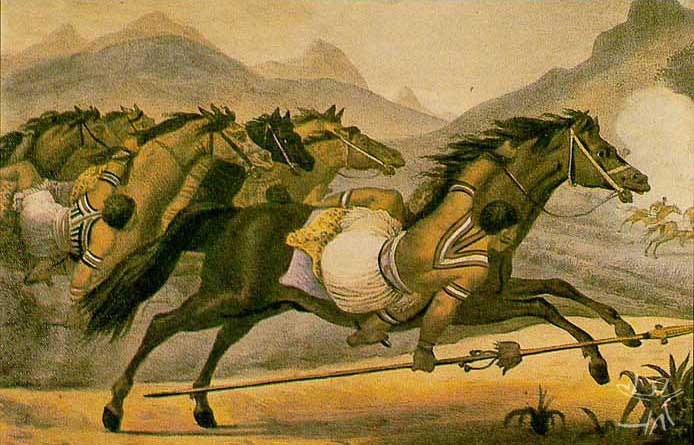
Also known as the 'índios cavaleiros' or 'horsemen Indians,' the Kadiwéu are members of a single surviving 'horde' of the Mbayá, a branch of the Guaikurú. They preserve the memory of a glorious past. Organized in a society polarized by nobles at one extreme and captives at the other, they lived off war spoils and tribute from their neighbours; in fact, they depended on the latter for their own biological reproduction, since their own women did not produce children or only allowed one child to survive when they were already towards the end of their fertile life. These women devoted themselves to body and facial painting, whose exceptional design of geometric elements was considered by Lévi-Strauss to be typical to hierarchical societies. Designs that impress by the richness of their forms and details. Today, these are made easily accessible to us through the vast collection collected by Darcy Ribeiro, reproduced in the book he published on the Kadiwéu.
Those captured during past warfare, preferentially children and women, were included in this society within a specific category, namely as 'captives' or gootagi (our captives) in Kadiwéu speech. The Guaikurú-Mbayá took captives from various other indigenous peoples, above all the Xamakôko, inhabitants of a region of Paraguay, their most important source. They also captured Whites - Portuguese or Spanish, Brazilians or Paraguayans - a practice attested both in the historical records and Kadiwéu memory. The Mbayá also maintained another kind of relationship, such as the one established with the Terêna (a subgroup of the peoples then called Guaná or Txané), a society also divided into strata. Here, they allowed marriage between their own nobility and Terêna women of the upper strata, thereby acquiring claims to the latter group's work, particularly their agricultural products.
In the Paraguayan War, they chose to fight for Brazil; this support later provided a basis for recognition of their lands, though even today their possession is not fully guaranteed.
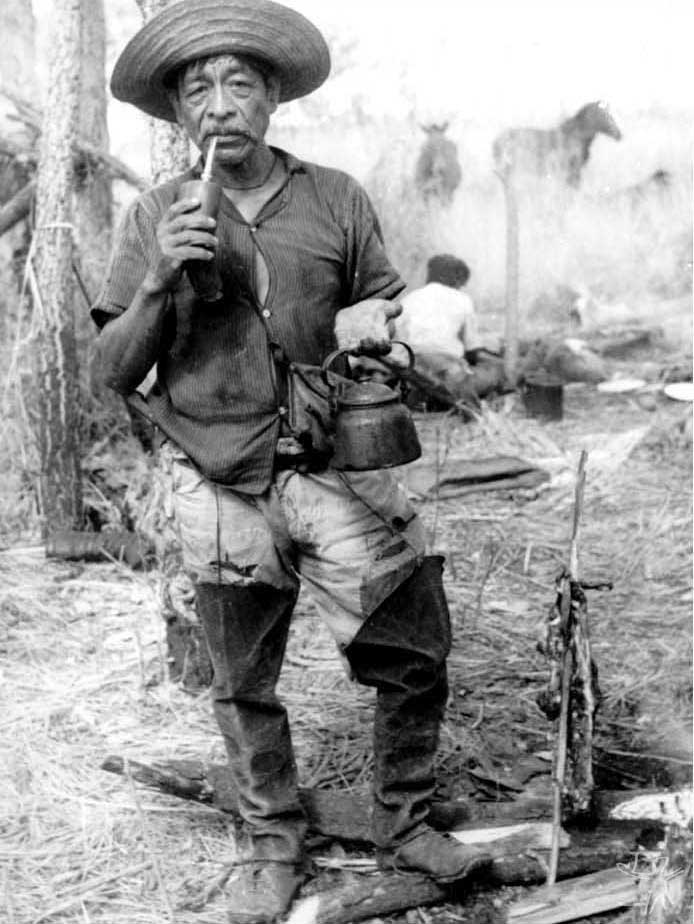
The adoption of a 'country' style of clothing by today's Kadiwéu men reveals their attachment to a way of life based on the breeding and use of horses, stocks of which they still rear, though much smaller than those of the past.
Language
The Kadiwéu belong to the Guaikurú linguistic family, which includes other peoples of the Chaco, namely the Toba (Paraguay and Argentina), the Emók or Toba-Mirí (Paraguay), the Mocoví (Argentina), the Abipón (extinct) and the Payaguá (extinct). The Kadiwéu are the most northerly of these Guaikurú groups and the only group located to the east of the Paraguay river, in Brazil.Some older men, women and above all children only speak Kadiwéu. However, a high number of Kadiwéu people communicate easily in Portuguese. There are many differences in the Kadiwéu language between male and female speech. It is interesting to note that the descendents of the Terêna who live among the Kadiwéu use only Portuguese to communicate within the village (they do not use the Terêna language even among themselves). Nonetheless, even though they do not speak the language, they understand Kadiwéu perfectly, since it is in this language that they are addressed.
Location
The Spanish colonizers used the name Mbayá (a term probably of Tupi origin) for the Guaikurú (also of Tupi origin) from whom the Kadiwéu descended. Originating on the western side of the Paraguay river, a section of the Mbayá crossed over to the eastern shore some time in 17th century. In response to the pressure from an expanding colonial frontier, they relocated further northwards and those who still had not migrated to the eastern shore of the river did so at the end of the 18th century. During this period, their territory extended from the mountain ranges separating the Paraná and Paraguay rivers to an area north of the 18°S parallel.
The Mbayá were divided into various hordes, each one with a specific name associated with the natural features of the regions they occupied. During the 18th century, the territory of one of these hordes, the Cadiguegodis, was drained by a creek called Cadigugi by the Indians. All the indications are that this latter horde were the ancestors of the latter-day Kadiwéu. The Kadiwéu horde was the last to migrate to the eastern shore of the Paraguay river and was the only surviving population by the second half of the 19th century.
The Kadiwéu, who the historical literature once called the horsemen Indians, due to their ownership of a vast equine herd and their admirable riding skills, nowadays live in a territory located in the State of Mato Grosso do Sul, in lands including an area of the Pantanal. The natural limits of their territory are formed in the west by the Paraguay and Nabileque rivers, in the east by the Serra da Bodoquena upland range, in the north by the Neutaka river and in the south by the Aquidavão river. Within this territory, the Kadiwéu population divides into four villages. The largest village, Bodoquena, is located in the northeast of the Indigenous Territory, at the foot of the Serra da Bodoquena, neighbouring the Campina village, which is found in the uplands above. Tomázia village is located in the south of the Indigenous Territory. The village of São João is also found in the south. The latter village is mostly inhabited by Terêna Indians and remnants of the Kinikináo population. Some Kadiwéu families still live in small groups, at localities deeper inside the Indigenous Territory further away from the main villages, where they breed small cattle herds.
The Kadiwéu Indigenous Territory is in the municipality of Porto Murtinho. Bodoquena is the closest town to the largest village (60 km), followed by Miranda and Aquidauana. Campo Grande (310 km) is the most important urban centre in strategic and administrative terms for the Kadiwéu. It is headquarters for the FUNAI administration charged with their jurisdiction, the association of tenant farmers (ACRIVAN - Aquidaban and Nabileque Valley Cattle Breeders Association) and ACIRK (Kadiwéu Reserve Indigenous Communities Association).
Demography
Data from Funai indicate that in 1999 the total Kadiwéu population under jurisdiction of the Bodoquena Indigenous Post (covering the Bodoquena and Campina villages and based at the former village) was 1,041 people. The population administered by the São João Indigenous Post, which covers the São João and Tomázia villages, now numbers 551 people according to the same source.
It should be noted that, as mentioned above, the village of São João is mainly inhabited by Terêna and Kinikináo Indians. As a result, the total population of 1,592 corresponds to the Indians of all three of these ethnic groups who inhabit the Kadiwéu Indigenous Territory and also includes the Kadiwéu who live outside it but coming from these villages. Results from a recent non-FUNAI census of the Kadiwéu population have not been included, since it makes no separation between the ethnic groups at the São João Indigenous Post, which renders calculation of the total Kadiwéu population impossible.
In 1992, during the period of Mônica Thereza Pechincha's research, 633 Kadiwéu lived in Bodoquena village, 39 at Campina village, 60 at Tomázia village and 67 at other locations within the Indigenous Territory, in addition to São João village which at the time numbered 170 inhabitants. For the purposes of observing demographic growth, I also present data from 1995, collated at the Campo Grande Regional Administration of FUNAI, which indicate the population of the Bodoquena Indigenous Post to be 951, and the São João Indigenous Post to be 388.
History of contact
The first report available on the Guaikurú dates from the 16th century, coming from a European expedition that penetrated the Chaco region in search of precious metals deep in the continent's interior. Many Mbayá groups were under the influence of missionary reductions from the start of the 18th century. During the same century and at the beginning of the following, the contact with colonizing fronts intensified with the establishing of military forts along the course of the Paraguay river, both Portuguese and Spanish, which disputed one another over the definition of borders. The towns founded in the region made up part of their historical context, very often marked by conflicts - though sometimes by accords, such as the one celebrated in 1779 among the Mbayá and the Spanish and another agreed in 1791 with the Portuguese.
A crucial point in their history of contact with non-Indian society, recollected with pride and vehemence, was the participation of the Kadiwéu in the Paraguayan Way. This participation was subsequently recorded in innumerable historical narratives recalling details of the event and carefully recording their heroic exploits. The Kadiwéu describe their vital participation in this war, fighting alongside the Brazilians and thereby winning the territory in which they now live as a just return. This provides their most effective argument for the incontestable - but ever threatened - ownership of their lands.
The Kadiwéu Indigenous Territory received its first official recognition at the turn of the 20th century in an Act passed by the Mato Grosso State Government. The area was demarcated in 1900 and a decree issued in 1903, which already established the same natural limits found today and mentioned above. On the 9th April 1931, decree no 54 ratified these limits. But territorial problems have been a constant aspect of their history and the Kadiwéu have not forgotten the attempts to invade their land and the conflicts that have unfolded since the start of the 20th century. More recently, the demarcation of their lands, concluded in 1981, was surrounded by heightened tension with invaders and left one of the Kadiwéu villages - Xatelôdo, located in the Serra da Bodoquena uplands - outside the perimeter. The resulting conflicts, notably those occurring in 1982 and 1983, were widely reported in the media.
This history has also been marked by inevitable conflicts with tenant farmers. Cattle ranchers started to penetrate Kadiwéu territory almost five decades ago, with reports of a first invasion in 1952. Since the end of the 1950s, they began to occupy this territory in another form with official authorization from the Serviço de Proteção ao Índio (SPI, the Indian Protection Service, a forerunner body to today's FUNAI). By 1961, 61 individual contracts with tenant farmers had already been signed. This occupation significantly altered the Indians' use of their own land. At the start of the 1990s, 89 tenant farms were located within the Kadiwéu Territory, extending across almost the entire territory such that the Indians are squeezed into the areas surrounding their own villages.
Social and political organization
In the past, the Mbayá hordes were divided into 'tolderias.' These communities, which comprised a collective house, was the smallest political and economic unit, which united the kindred of a 'chief' and his captives. The families of 'chiefs' comprised Mbayá from birth, who nowadays are identified as families of 'pure' Kadiwéu, as they refer to themselves, or the goniwtagodepodi ejiwajigi ('our Kadiwéu masters'), where ejiwajigi is their auto-denomination. Goniwtagodi, or goniwaagodi, according to male or female speech, respectively (there is a linguistic distinction between the two), is a term of address that the Kadiwéu use for any person of the male sex, including outsiders. In the same way, women are addressed by the terms goniwtagodo (in male speech) or goniwaagodo (in female speech). They also address children by these terms, which translate as master and mistress (goniwtagodi = our master, iniwtagodi = my master). The chiefs were all descendents of chiefs, by any line or degree, including those of female sex (the 'chiefesses'). Since the nucleus of 'pure' Kadiwéu was reduced due to a low birth rate, some captives doubtless had to be incorporated, possibly via marriage, though this was not the preferred option. In the past, the Kadiwéu claim, the masters did not marry their captives, a rule that cannot now be verified. A hierarchical distinction between those who consider themselves 'pure' Kadiwéu and descendents of captives still exists in this society. Today only two families claim the status of masters in the Bodoquena village. Both dispute political hegemony of the group. The relationship of 'captivity' is most clearly observable in ritual practices. For example, when there is an activity in which boys and girls participate for the first time, they must be represented at this moment by one of their captives. In terms of day-to-day activities, all families in general act in an autonomous way and as a unit.
In 1992, the Kadiwéu of the Bodoquena village were distributed between 110 houses, which usually shelter nuclear families, generally composed of kindred groups and preferentially obeying a matrilocal rule. Marriages with the Terêna are very frequent. At this time, in the Bodoquena village alone, in 28 nuclear families one spouse was Terêna. This is without counting those who have ancestors from the latter ethnic group.
Political decisions and those of general interest to the group are strongly centred on the figure of the chief and his advisers. The right to become chief is hereditary. Today, this right is recognized to belong 'naturally' to the firstborn great-grandchild of the Little Chief, a venerated past leader. However, the rules determining access to the chiefdom have become more flexible. The 'captains,' a term that refers to the chief or 'cacique,' are nowadays chosen from within the group and, over the course of their recent history, various chiefs have succeeded one another in short periods. These do not always belong to 'chiefly families' and when they do not belong to these lineages, their political positions does not alter their social status. The chief is advised by a council, made up primarily of older and more experienced men. It should be noted, nonetheless, that the political role of younger leaders is equally strong: the latter have gained prestige mostly due to their degree of formal education (some of them even possess high school diplomas) and their knowledge of Portuguese, a highly useful skill during external negotiations.
Art
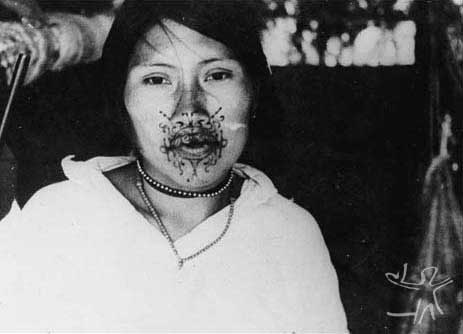
The fine body designs made by the Kadiwéu are one of the most notable forms of their artistic expression. Skilled painters cover faces with minute symmetric designs, drawn with a paint obtained from a mixture of genipap juice plus powdered charcoal and applied with a fine sliver of wood or bamboo. In the past, body painting marked the difference between nobles, warriors and captives.
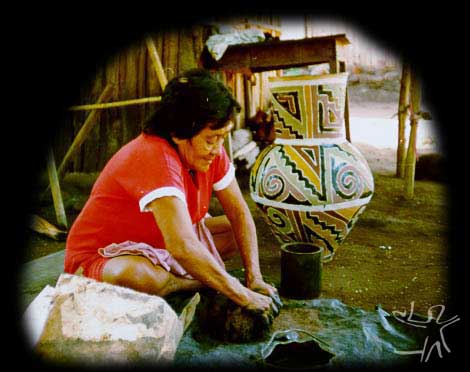
Kadiwéu women produce equally beautiful items of pottery: vases of various sizes and shapes, plates also of various sizes and depths, animals, and wall decorations, among other creative pieces. Each woman decorates these items with distinct patterns, adhering to a rich but fixed repertoire of forms completed with varying colours. The raw material for their work derives from special clay pits, which contain clay of an ideal consistency and tonality for making durable pottery. The pigments for the painting are acquired from sands of a wide variety of tones, while some of the details are varnished with holywood tree resin.
Kadiwéu art is also expressed in the songs of the older women, in the music of the flute and drum players, and in the collective dances.
Narratives

Warfare based on capturing enemies provided the basis of Kadiwéu social organization. The memory of warfare is very present and always resurges in self-defining discourses, as well as acting as a resource in their present-day relationship with non-Indian society. The warrior ideal is a source of values that still guide their practices. Various Kadiwéu myths mention the Godapoagenigi; those warriors who stood out through their courage and physical strength. Among the narratives that I heard from their rich repertoire, the Kadiwéu distinguish at least two classes. One of these they call 'stories of awe,' or 'stories that produce miracles,' 'sacred stories,' closer to the category of myths properly speaking. Another class is comprised by 'stories that really happened,' which are presented as an 'historical description' of events such as the wars of the past.
It is from 'stories of awe' that the Kadiwéu extract their personal names - I have also called them 'nomination myths.' Many of these myths are the property of chiefs' families, and the personal names that derive from them may be used by their descendents and captives. In many of these stories, the protagonists are mythological ancestors of chiefs' families.
Some others also contain mythical personae who are ancestors of captives and whose descendents use their names. These myths contain teachings, advice and precepts. Each one effectively explains and prescribes a custom: the act of capturing children in warfare, female initiation, the use of drinks made from honey, certain remedies, food taboos. The creation myth - also included in this category - tells of the beginnings of Kadiwéu society and of that which distinguishes it from all the other societies with which they maintain or maintained contact, interweaving comments about the latter and about this relationship.
Rites
The Kadiwéu individual receives a name at his or her birth and whenever a kinsperson dies. During the funerary rites, the kin of the deceased have their hair cut. Someone who cuts his or her hair in a sign of mourning is called okojege. Older women, who know these rites, meet during the funeral to decide the most suitable name for the mourner. When someone loses a close kinsperson, it is also possible to adopt another person (independent of age, sex and the degree or even existence of kinship) to fill the absence left by the deceased. A kinsperson adopted in these circumstances is called godokogenigi. The latter is also given a new name and his or her hair is cut. There is yet another way to establish a tie of kinship 'of consideration.' This is through the relationship between imedi (or imeeti in the case of women, a word translated as 'friend'). Two families can agree to make a child from each an imedi, who then establish a fraternal relationship between themselves with the particular appropriate attitudes. The descendents of the two imedi will also be imedi to each other.
In addition to funerary rites, they also practice what they call a 'Girl's Festival.' A female initiation ritual, the girl undergoes a two day reclusion and a rigorous diet after she starts her first menses. She cannot step on the ground nor look at animals. At the ritual's climax, this girl is 'fanned' with a red cloth hemmed with beads and baubles (the 'fan,' wajuide) and, lying prone, is pressed above the kidneys by a woman from the village carefully chosen by her family, since her characteristics will be assimilated by the girl.
The Boat, or Etogo, is considered by the Kadiwéu to be the ritual most clearly expressive of their alterity, since, as they say, it is the clearest in displaying that they are 'really Indians.' It was last performed in 1992 after at least fifty years during which it had not been staged. It has not been repeated since. The immediate motive for its performance was the need to show the Whites, their guests, the ritual that most expressed their identity.
The Boat is a long ritual. It refers to the Paraguayan War, noted, among other aspects, by the planting of stylized Brazilian and Paraguayan flags to either side of the bamboo boat built as the setting for the ritual. The Boat mimics a war boat similar to those the Kadiwéu say they saw navigating the Paraguay river in the past.
The chief of the Boat is the persona called Maxiotagi, or the 'Macho.' Maxiotagi is a Xamakôko persona (although the actor is Kadiwéu), from the ethnic group that was the main source of captives in the past. His function in the ritual is to direct its scenes as they develop.
Maxiotagi, who is blind, is accompanied by Ligecoge, 'the Macho's eyes', and Lionigawanigi (Small One), who assist him in his activities. These personae decorate themselves with comical attire. The Boat also features the Delegate, the Sergeant (Jajentege), the war chiefs and the convent clerks (Nidikuna). There is also Ixotece Gonibedona Gonibegi, or 'Finger-in-the-Arse,' who is in charge of the 'watch.' The maximum rule during the Boat is that one cannot laugh, under penalty of being imprisoned and/or paying 'bail,' generally charged in the form of cattle to be slaughtered there and then, supplying the collective barbecue held over the several days of the ritual.
During the ritual period, the village's routine is completely altered and everyone behaves as though under a voice of command, only acting in accordance with the chief's orders. During the Boat, all the men of the village are called 'soldiers' and all the women 'Paraguayans' (gaxianaxe), and represent war captives. There is also a specific role for the older women, who are the ones who keep the group's sacred chants. These women - the only people who know the language of the chants, which young men do not know how to translate - sing in a sudden fashion whenever an important event happens to the group. Their chants recall historical facts and preserve the memory of the chiefs and their great feats, as well as providing commentaries on contemporary events based on their history and cosmology. The older women sing (or 'pray') during the Boat for release of the captives.
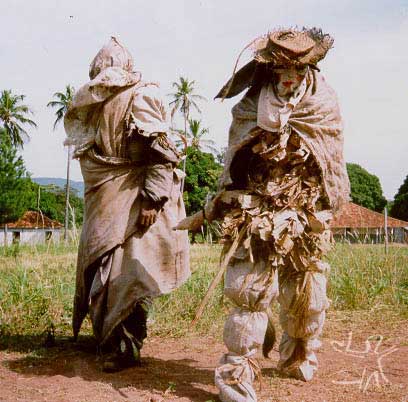
Ritual moments are also accompanied by both male dances (nabacenaganaga, or 'stick-beating') and female dances, by music played on their typical instruments, the flute (natena) and the drum (goge), by joking and games (especially those displaying the physical performance of the men, recalling the godapoagenigi), and by the presentation of 'clowns' (bobotegi). These are personae who also appear outside of the Boat ritual. They make their appearance in masks with their body also camouflaged and unrecognisable, dancing their odd 'polkas' and scaring the children who ply them for presents.
There is also a Father in the Boat, who performs baptisms imitating the Christian priests and simulates curing rites, such as those performed by the nijienigi (the Kadiwéu shaman). The nijienigi is capable of foreseeing future events with the help of spiritual entities who guide him. As a result, his role was a fundamental aspect of war strategies in the past. The nijienigi also cure and are still summoned to intervene in cases of sickness in the villages.
Note on the source
The most important historical reference on the Kadiwéu (or the Guaikurú-Mbayá) is found in the work of F. José Sanchez-Labrador, entitled El Paraguay Católico, considered one of the best ethnographies written in the 18th century.
Various 19th century chroniclers recorded, in greater or lesser detail, their impressions of these Indians, their localization, way of life and relations with the colonizers. Standing out among them are Ricardo Franco de Almeida Serra, Francisco Rodrigues do Prado, Alexandre Rodrigues Ferreira, Francis Castelnau, Alfred d'Escragnole Taunay (who narrated episodes concerning the indigenous participation in the Paraguayan War) and, most notably, Guido Boggiani. The last author lived for several months among the Kadiwéu at the end of the 19th century and amid other writings left us his rich field diary relating to the visit, published as Os Caduveos. Boggiani collected a vast amount of material representing Kadiwéu art and artefacts, whose most important collection is found today conserved by the Luigi Pigorini Museum, in Rome. Historical information can also be derived from the reports of Presidents of the Province of Mato Grosso, kept by the National Archive.
As for anthropological works properly speaking, Alfred Métraux provides us with ethnological studies on the Indians of the Grand Chaco, especially on those aspects concerning religion. Claude Lévi-Strauss stayed among the Kadiwéu in 1937 and wrote about their art. Darcy Ribeiro pursued field research among the Kadiwéu at the end of the 1940s and his most important works on the group are collected in the volume Kadiwéu: Ensaios Etnológicos sobre o Saber, o Azar e a Beleza, which, as the title indicates, deals with mythology, shamanism and art. He also wrote an article: 'O sistema familial Kadiwéu' (1948). More recently, two M.Phil. theses have been written on the people: the thesis by Jaime Siqueira Jr. (USP, 1993) studies the construction of Kadiwéu time and space; Mônica Thereza Pechincha's thesis is entitled Histórias de Admirar: Mito, Rito e História Kadiwéu (UnB, 1994). The Kadiwéu language has been studied by Silvia L.B. Braggio (1981). As for technical reports, it is worth mentioning those produced by Alain Moreau, who has frequented and accompanied Kadiwéu society for a number of years and through his own initiative has provided them with valuable juridical support, especially in effecting the process of substituting the farm tenancy system.
Sources of information
- BEHR, Miguel von. Os Cadiueu. In: BEHR, Miguel von. Serra da Bodoquena : história, cultura, natureza. Campo Grande : Free, 2001. p. 53-61.
- BOGGIANI, G. Os Caduveos. Belo Horizonte : Itatiaia, 1975.
- BRAGGIO, Silvia Lúcia Bigonjal. Aspectos fonológicos e morfológicos do kadiwéu. Campinas : Unicamp, 1981. (Dissertação de Mestrado)
- CACERES, Luiz d’Albuquerque de Mello Pereira e. Exploração do Rio Paraguay e Primeiras Práticas com os índios Guaikurús. Rev. Trimensal do Instituto Histórico Geográfico e Ethnographico do Brasil, s.l. : IHGEB, v. 28, p. 70-117, 1865.
- CASTELNAU, Francis. Expedição às Regiões Centrais da América do Sul. v. 2. São Paulo : Cia. Ed. Nacional, 1949.
- D’ALINCOURT, Luiz. Reflexões sobre o systema que se deve adoptar na fronteira do Paraguay, em conseqüência da revolta e dos insultos praticados ultimamente pela nação dos Índios Guaicurus ou cavalleiros. Rev. Inst. Hist. Geogr. Bras., s.l. : IHGB, v. 20, p. 360-5, 1857.
- FERREIRA, Alexandre Rodrigues. Viagem Filosófica pelas Capitanias do Grão Pará, Rio Negro, Mato Grosso e Cuiabá. Rio de Janeiro : Conselho Federal de Cultura, 1974. 162 p.
- --------. A Gruta do Inferno. Rev. Trim. Hist. Geogr., s.l. : s.ed., n. 4, p. 360-5, 1842
- FRIC, Pavel; FRICOVA, Yvonna (Orgs.). Guido Boggiani Fotógrafo. Praga : Nakladatelstvi Titanic, 1997. 139 p.
- GENTILE, Brigidena (1984). I Caduvei tra mito e stória : la conservazione di un modello di comportamento da parte di una popolazione del Mato Grosso del Sud, Brasile. Roma : Universitá degli Studi, 1984. (Tese de Doutorado)
- GRIFFTHS, Glyn. Gramática Pedagógica Kadiwéu. Brasília : SIL, 1986
- KOLLER LECZNIESKI, Lisiane - 2005. Estranhos Laços: predação e cuidado entre os Kadiwéu, Tese de doutoramento em antropologia social, Universidade Federal de Santa Catarina, Florianópolis.
- LÉVI-STRAUSS, Claude . Saudades do Brasil. São Paulo : Companhia das Letras, 1994. 227 p.
- --------. Tristes Trópicos. São Paulo : Companhia das Letras, 1996.
- MANGOLIM, Olívio. Povos indígenas no Mato Grosso do Sul : viveremos por mais 500 anos. Campo Grande : Cimi-MS, 1993. 120 p.
- MÉTRAUX, Alfred. Ethnografy of the Chaco. In: STEWARD, Julian H. (Ed.). Handbook of South American Indians. v. 1. New York : Cooper Square Publishers, 1963. p. 197-370.
- OBERG, Kalervo. The Terena and the Caduveo of Southern Mato Grosso, Brazil. Washington : Smithsonian Institution, 1949. (Institute of Social Anthropology, Publication, 9).
- OLIVEIRA, Roberto Cardoso de. Do Índio ao Bugre. Rio de Janeiro : Francisco Alves, 1976.
- PADILHA, Solange. A arte como trama do mundo : corpo, grafismo e cerâmica Kadiweu. São Paulo : PUC, 1996. 218 p. (Dissertação de Mestrado)
- PECHINCHA, Mônica Thereza Soares. Histórias de admirar : mito, rito e história Kadiwéu. Brasília : UnB, 1994. 148 p. (Dissertação de Mestrado)
- PRADO, Francisco Rodrigues do. História dos índios Cavalleiros ou da Nação Guaycurú, Rev. Inst. Hist. Geogr. Brasil., s.l. : IHGB, v. 1, p. 25-57, 1939.
- RIBEIRO, Darcy. A arte dos índios Kadiwéu. Rev. Cultura, s.l. : Min. da Ed. e Saude, s.n., p. 147-90, s.d.
- --------. Kadiwéu : ensaios etnológicos sobre o saber, o azar e a beleza. Petrópolis : Vozes, 1980.
- --------. Religião e mitologia Kadiwéu. Rio de Janeiro : SPI, 1950. 237 p.
- --------. Sistema familial Kadiwéu. Rev. do Museu Paulista, São Paulo : Museu Paulista, v. 2, n.s., p. 175-92, 1948.
- RIBEIRO, José Hamilton. A vingança do índio cavaleiro. São Paulo : Moderna, 1995. 72 p.
- RIVASSAU, Emílio. A Vida dos Índios Guaycurús, São Paulo : Cia. Ed. Nacional, 1936.
- ROHAN, Henrique de Beaupaire. De Cuiabá ao Rio de Janeiro pelo Paraguai, Corrientes, Rio grande do Sul e Santa Catarina, Rev. Inst. Hist. Geogr. Brasil., s.l. : IHGB, v. 9, p. 376-97, 1869.
- SANCHEZ-LABRADOR, José. El Paraguay Católico. 2 v. Buenos Aires : Imprenta de Coni Hermanos, 1910.
- SANDALO, Filomena. A grammar of Kadiweu : with special reference to the polysynthesis parameter. Cambridge : MTIWP, 1997. 137 p. (MIT Occasional Papers in Linguistics, 11)
- SCHMÍDEL, U. Viaje al Rio de La Plata. Buenos Aires : Cabaut y Cia. Ed., 1903.
- SERRA, Ricardo Franco de Almeida. Parecer sobre o aldeamento dos índios Uaicurus e Guanás com a descripção dos seus usos, religião, estabilidade e costumes. Rev. Inst. Hist. Geogr. Brasil., s.l. : IHGB, v. 7, p. 204-18, 1845. --------. Continuação do parecer sobre os índios Uaicurús e Guanás. Rev. Inst. Hist. Geogr. Brasil., s.l. : IHGB, v. 13, p. 348-95, 1850.
- SIQUEIRA JÚNIOR, Jaime Garcia. Arte e técnicas Kadiwéu. São Paulo : Secretaria Municipal de Cultura, 1992. 125 p.
- --------. “Esse campo custou o sangue dos nossos avós” : a construção do tempo e espaço Kadiwéu. São Paulo : USP, 1993. 290 p. (Dissertação de Mestrado)
- --------. Kadiwéu : as dificuldades da gestão direta dos arrendamentos. In: RICARDO, Carlos Alberto (Ed.). Povos Indígenas no Brasil : 1987/88/89/90. São Paulo : Cedi, 1991. p. 538-42. (Aconteceu Especial, 18)
- TAUNAY, Alfred d’Escragnole. Entre Nossos Índios. São Paulo : Melhoramentos, 1923. --------. A Retirada da Laguna. São Paulo : Melhoramentos, 1963.
- VINHA, Marina. Memórias do guerreiro, sonhos do atleta : jogos tradicionais e esporte entre jovens Kadiwéu. Campinas : Unicamp, 1999. (Dissertação de Mestrado)
- WILBERT, Johannes; SIMONEAU, Karin (Eds.). Folk literature of the Caduveo indians. Los Angeles : Univ. of California, 1987. 214 p. (Ucla Latin American Studies, 71)
- A propos de tristes tropiques. Dir.: Jorge Bodansky; Patrick Menget. Vídeo Cor, U-Matic, 50 min., 1991. Prod.: Yves Billon; Les Filmes du Village