Constitutional rights of the indigenous peoples
The constitutional Rights of the indigenous peoples are expressed in a specific chapter of the Constitution of 1988 (title VIII, "Of the Social Order ", chapter VIII, "of the indigenous peoples"), aside from other regulations throughout the text and an article of the Acts of the Transitory Constitutional Regulations.
This deals with the Rights marked by at least two innovative and important concepts in relation to prior Constitutions and the so-called The Indian Statute. The first innovation is the abandonment of the assimilationist point of view, which considered the indigenous peoples as a transitory social category, destined to disappear. The second innovation is that the rights of the indigenous peoples over their lands are defined in the concept of original rights that are prior to the creation of the State itself. This is a result of the de facto historical recognition that the indigenous peoples were the first occupants of Brazil.
The new Constitution establishes, in this manner, a new outlook for the relations between the State, Brazilian society and the indigenous peoples.
Right to be different
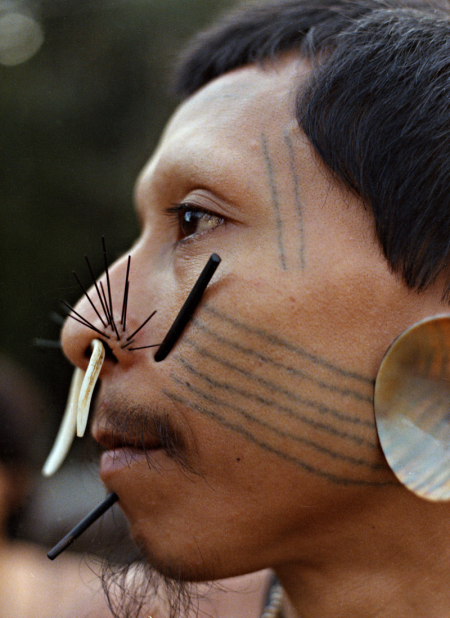
With the new constitutional concepts, the indigenous peoples were assured of respect for their social organization, customs, languages, beliefs and traditions. For the first time, the indigenous peoples of Brazil were recognized as having the right to be different, that is, to be indigenous peoples and remain that way indefinitely. This is stated in the head of article 231 of The Constitution:
It is recognized that the indigenous peoples have the right to their social organization, customs, languages, beliefs and traditions, and their original rights over the lands that they have traditionally occupied, it being the duty of the federal government to demarcate these lands, protect them and ensure that all their properties and assets are respected”.
Note that the right to be different does not imply fewer rights or privileges because the Constitution of 1988 assured indigenous peoples the right to use their languages and own processes for education at the primary school level (Article 210, § 2º), thus inaugurating a new phase for the implementation of indigenous grade school education.
Furthermore, the Constitution allows the indigenous peoples, their communities and organizations, just as any individual or corporate entity in Brazil, the right to file suit in court in the defense of their rights and interests.

Indigenous peoples's rights to their land
The new Constitution was innovative in every sense, establishing above all that the Rights of the Indians to the lands they traditionally occupy are of an original nature, in the sense that they are original to the land, prior to the formation of the Brazilian state or government, existing independently of any official recognition.
The text in force gives a constitutional category or status to the concept of indigenous lands, which is defined as follows in paragraph 2 of Article 231:
Lands traditionally occupied by the Indians are those that they have inhabited permanently, used for their productive activity, their welfare and necessary for their cultural and physical reproduction, according to their uses, customs and traditions."
These characteristics, therefore, define a specific area of land as being indigenous. Once these characteristics are present, and are verified in accordance with the uses, custom s and traditions of indigenous people’s the right to the land by the community that occupies it is an existing right and its legitimized independently of any constitutional act. In this sense, the demarcation of indigenous land, the result of recognition by the state, is an act that merely states or declares that said land is indigenous, and its objective is simply to delineate the real extension of their title to ensure the full efficacy of the the constitutional ruling and the State has the obligation to protect these indigenous lands
With regard to Indigenous lands, the Constitution of 1988 stipulates further that:
- they are included as part of the assets of the union;
- their use is specified for the permanent holding and title by the indigenous peoples;
- all juridical acts that affect this ownership and title are nullified and extinct, except the relevant public interest of the federal government;
- only the indigenous people can utilize and have the right to use the assets derived from the soil, the rivers and the lakes in these areas;
- the use of the water power resources, including energy potential, research, assays and mining claims can only be valid with the authorization of Congress, after a hearing with the communities that are affected, and the community is assured a participation in the results of the mining activities on their lands’;
- new ordinary legislation (not constitutional change) is needed to specify the conditions for mineral exploration and the use of water resources on indigenous lands;
- the indigenous lands cannot be sold, mortgaged or encumbered in any way and are unavailable for said activities; and the right to these lands by the respective indigenous peoples can never expire;
- it is prohibited to remove the Indians from their lands, except in exceptional and temporary conditions, as stipulated in § 6º - Article 231.
In the Transitory Constitutional regulation, five years was stipulated as the time frame for the demarcation of all the indigenous lands . This deadline was not honored, and the demarcations are still a matter that is still pending.
Other rulings
Other regulations and rulings are scattered through the text of the Constitution:
- The responsibility to judicially defend the indigenous rights, is included among the attributions of the Federal Prosecutors’ Office;
- Legislating about indigenous peoples is the exclusive function of the federal government;
- The act of filing suit and judging indigenous rights is the function of the federal judges;
- The state must protect the manifestations of popular cultures, including those of indigenous peoples.
Veja também
Texto completo da '''Constituição da República Federativa do Brasil de 1988''' disponível no Portal do Planalto
== In practice ==
The Constitution of 88 created the need to set up a review via ordinary legislation and the inclusion of new themes in the juridical debate about the indigenous communities. Beginning in1991, law bills were presented by the executive branch of the government and by deputies to regulate the constitutional clauses and adapt the old legislation based on the principles of the integration of the indigenous communities in the national community and the tutorial relationship between the government and the indigenous groups to the terms of the new Constitution.
Thus, the legal basis in support of the most fundamental claims of the Indians in Brazil was formulated by the new Constitution and has been currently expanded and rearranged. However, Brazilian reality shows that it is up to the indigenous communities and their allies to make it possible to enforce the difficult task of making the laws complied with, guaranteeing the respect of indigenous rights in practice, in the face of many different economic interest that had the audacity to ignore the existence of these rights.
To ensure that the constitution is enforced is the challenge that is face. It is the role of the indigenous communities, as well as their organizations, support entities, universities, the prosecutors’ office and other groups. It is well known that this is a slow process, and is actually conditioned by the task of making society as a whole aware of the situation. Success will necessarily depend on the degree of commitment on a day-to-day basis on the part of everyone involved in this effort.== Previous Constitutions ==
All the constitutions of the republican period, except the omission of the Constitution of 1891, recognized the Indigenous Community rights over the territories they inhabit:
The Constitution of 1934
"Art. 129 – The possession and occupation and rights to the land of the indigenous communities where they are permanently located will be respected, and it is prohibited to sell or encumber their rights to the land in any way, shape or form."
The Constitution of 1937
"Art. 154 –The possession and occupation and rights to the land of the indigenous communities where they are permanently located will be respected, and it is prohibited to sell or encumber their rights to the land in any way, shape or form."
The Constitution of 1946
"Art. 216 – The possession and occupation and rights to the land of the indigenous communities where they are permanently located will be respected, on the condition that they do not transfer their rights to the land."
The Constitution of 1967
"Art. 186 – The possession and occupation and rights to the land of the indigenous communities where they are permanently located is recognized, as well as their exclusive y rights to use the land and the natural resources and all the utilities existing therein.” Constitutional Amendment 1/ 1969
"Art. 198 – The lands inhabited by the indigenous communities cannot be encumbered or transferred in the terms that the federal law specifies, The possession and occupation and rights to the land of the indigenous communities where they are permanently located is recognized, as well as their exclusive rights to the utilization of the natural resources and all the utilities existing therein.".